Henri Adrien Tanoux: A Master of Sensual Orientalism
Henri Adrien Tanoux (1865-1923) remains a fascinating and somewhat enigmatic figure in the history of French art, particularly within the realm of Orientalist painting. His work, characterized by its lush sensuality, exotic locales, and captivating portrayals of women, offers a unique window into the artistic currents of late 19th-century Europe and its fascination with the “Orient.” Tanoux’s career unfolded largely outside the established Parisian art circles, yet his distinctive style gained him a devoted following and secured his place as a significant, if often overlooked, contributor to the genre.
Born in Paris, Tanoux received his initial artistic training at the École des Beaux-Arts. However, he quickly gravitated away from the academic traditions of the institution, seeking instead inspiration in travel and personal experience. Crucially, Tanoux spent a considerable portion of his life in North Africa, primarily Morocco and Algeria, immersing himself in the culture, landscapes, and people of these regions. This extended sojourn proved to be the defining influence on his artistic vision, shaping not only the subject matter of his paintings but also the very manner in which he approached composition, color, and light. Unlike many of his contemporaries who relied solely on secondhand accounts or sketches, Tanoux sought direct engagement with the environment, allowing him to capture a remarkably authentic sense of atmosphere and detail.
The World of *Namouna* and Harem Beauties
Tanoux’s most famous work, *Namouna* (1894), is a pivotal piece in understanding his artistic trajectory. This large-scale painting depicts a scene from the life of a Moroccan harem, featuring a strikingly beautiful woman – often identified as a slave girl named Namouna – and a group of other women engaged in various activities. The painting’s notoriety stems from its controversial depiction of female sexuality and the complex social dynamics within the harem setting. It's important to note that *Namouna* was not simply a straightforward portrayal of exoticism; Tanoux meticulously researched the subject matter, consulting with local informants and striving for an honest representation of Moroccan life. The painting’s impact extended beyond the art world, sparking debate about colonialism, gender roles, and the ethics of artistic representation.
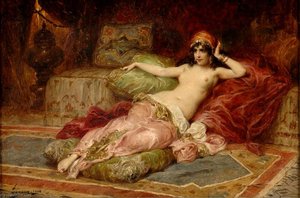
Beyond *Namouna*, Tanoux produced a prolific body of work centered around similar themes: elegant ladies in luxurious settings, harem beauties bathed in warm light, and evocative landscapes that seamlessly blended European and North African aesthetics. His paintings frequently showcase a masterful command of color and texture, creating an almost palpable sense of warmth and sensuality. He was particularly adept at capturing the subtle nuances of human expression, imbuing his subjects with a quiet dignity and inner life.
Technique and Influences
Tanoux’s artistic style can be characterized by a blend of influences. While he undoubtedly drew inspiration from earlier Orientalist painters such as Eugène Delacroix and Jean-Léon Gérôme, he developed a distinctly personal approach. His brushwork is loose and expressive, often employing visible strokes to convey texture and movement. He was also deeply influenced by the Barbizon School, known for its emphasis on plein air painting and naturalistic observation. However, unlike the Barbizon artists who primarily depicted rural landscapes, Tanoux utilized his outdoor studies to inform his portrayals of exotic locales.
The use of light is a particularly noteworthy aspect of Tanoux’s technique. He skillfully employed chiaroscuro – the dramatic contrast between light and shadow – to create a sense of depth and atmosphere. His paintings are often bathed in golden light, evoking a feeling of warmth and intimacy. Furthermore, his color palette—rich reds, oranges, and browns—mirrors the hues found in the landscapes and textiles of North Africa, further enhancing the illusion of authenticity.
Legacy and Historical Significance
Despite facing periods of obscurity, Henri Adrien Tanoux’s work has experienced a resurgence of interest in recent decades. His paintings are now recognized as significant examples of Orientalist art, offering valuable insights into the complex relationship between Europe and North Africa during the late 19th century. Tanoux's willingness to engage directly with Moroccan culture—to travel extensively, study local customs, and depict his subjects with a degree of sensitivity—sets him apart from many of his contemporaries.
Furthermore, Tanoux’s exploration of female sexuality in *Namouna* remains a subject of ongoing debate and critical analysis. His painting challenges conventional notions of beauty and representation, prompting viewers to consider the ethical implications of artistic appropriation and the power dynamics inherent in colonial encounters. Henri Adrien Tanoux's legacy lies not only in his stunningly beautiful paintings but also in their capacity to provoke thought and stimulate dialogue about art, culture, and history.