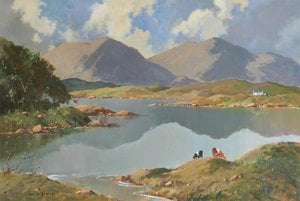
George K. Gillespie (1924–1995): A Pioneer of Color Field Painting
George K. Gillespie (1924–1995) stands as a significant figure in the American Abstract Expressionist movement, particularly recognized for his distinctive approach to color field painting—a style characterized by expansive canvases dominated by unbroken areas of pigment. Born in Belfast, Ireland, Gillespie’s artistic journey began with formal training at Belfast College of Art, where he honed his skills in jewelry and silversmithing alongside exploring the burgeoning realm of painting. This dual interest would prove formative, shaping his visual vocabulary and informing his later explorations into abstraction. His relocation to Hollywood, California, in 1957 marked a pivotal moment, immersing him in the vibrant artistic milieu of Southern California and fostering connections with influential artists like R. Boyd Morrison. Morrison’s guidance profoundly impacted Gillespie's artistic development, encouraging him to embrace bold experimentation and pushing him toward a more expressive style. This period solidified his commitment to painting as a primary medium and established the foundation for his subsequent career.- Early Influences: Gillespie’s formative years were marked by exposure to European Modernism, notably Impressionism and Cubism, which instilled in him an appreciation for tonal variation and geometric forms—elements that would subtly permeate his later works.
- Formal Training & Artistic Exploration: Studying at Belfast College of Art provided Gillespie with a grounding in traditional techniques while simultaneously nurturing his curiosity about innovative artistic approaches.
- Collaboration with R. Boyd Morrison: Morrison’s mentorship proved instrumental in shaping Gillespie's artistic vision, fostering a spirit of experimentation and encouraging him to delve deeper into abstraction.
The Rise of Color Field Painting
Gillespie emerged as a key proponent of color field painting during the mid-1960s, aligning himself with artists like Barnett Newman and Mark Rothko who championed this revolutionary style. Unlike representational art that strives to depict recognizable subjects, color field painting prioritizes pure pigment—often applied in large, uninterrupted swathes—to evoke emotional resonance and explore fundamental visual concepts. Gillespie’s canvases exemplify this ethos, conveying a sense of serenity and contemplation through meticulously calibrated hues and textures.- Newman & Rothko: Gillespie's artistic sensibilities were profoundly influenced by the pioneering work of Barnett Newman and Mark Rothko, who championed color field painting as a vehicle for spiritual expression.
- Emphasis on Texture & Tone: Gillespie’s paintings distinguish themselves through subtle variations in texture and tone—elements that contribute to their immersive quality and invite viewers to engage with the artwork on an emotional level.
Notable Works & Artistic Style
Gillespie's oeuvre comprises numerous canvases that showcase his mastery of color field technique. Recurring motifs include horizontal bands of pigment—often juxtaposed against darker backgrounds—that create a dynamic interplay between light and shadow. His palette leans heavily toward muted tones—primarily blues, greens, and yellows—reflecting the artist’s fascination with natural landscapes and conveying a sense of quiet contemplation. The deliberate simplicity of his compositions underscores Gillespie's belief that art should transcend literal representation, prioritizing instead the conveyance of feeling and intuition.- Recurring Motifs: Gillespie consistently employed horizontal bands of pigment—often contrasted against darker hues—to generate visual tension and evoke profound emotional responses.
- Palette & Color Harmony: His favored color palette consisted predominantly of blues, greens, and yellows, harmoniously blended to create a tranquil atmosphere that mirrored his appreciation for the natural world.
Legacy & Historical Significance
George K. Gillespie’s contribution to Abstract Expressionism extends beyond his individual artworks; he embodies the spirit of artistic innovation and intellectual inquiry that characterized the era. His unwavering dedication to exploring color and form—coupled with his profound sensitivity to visual perception—established him as a visionary artist who anticipated many trends in contemporary art. Gillespie's work continues to inspire artists today, serving as a testament to the enduring power of abstraction and its capacity to communicate complex emotions and ideas. He remains an important figure in the history of American painting, cementing his place among the luminaries of mid-century modernism.Pitanja i odgovori
Mogu li sortirati djela umjetnika George K Gillespie prema boji?
Stranica Spektralni indeks organizira djela umjetnika George K Gillespie prema boji.
Gdje mogu vidjeti djela umjetnika George K Gillespie prikazana kronološkim redom?
Djela umjetnika George K Gillespie mogu se vidjeti kronološkim redoslijedom na stranici Kronologija umjetnina umjetnika.
Kako mogu pronaći djela umjetnika George K Gillespie u određenoj paleti boja?
Kako biste pronašli djela umjetnika George K Gillespie u određenoj paleti boja, posjetite stranicu Prema paletama boja za tog umjetnika.