A Pioneer of Plasma Physics: The Unexpected Artistic Vision of Friedrich E. Wagner
Friedrich E. Wagner, born in Pfaffenhofen an der Roth, Germany, in 1943, is a name primarily recognized within the scientific community as a groundbreaking physicist specializing in plasma physics. His career trajectory initially followed a path dedicated to unlocking the secrets of fusion energy, culminating in significant discoveries at institutions like the Max Planck Institute for Plasma Physics and leadership roles within European scientific societies. However, beyond his contributions to the realm of controlled nuclear fusion – notably the discovery of the high-confinement mode (H-mode) which revolutionized plasma containment – lies a lesser-known but compelling artistic practice centered around the “Dürer Series.” This duality—the rigorous logic of physics and the evocative power of art—forms the core of Wagner’s unique story. He pursued his studies at the Technical University of Munich, earning his doctorate in 1972 before embarking on postdoctoral research at Ohio State University. It was during this period that he transitioned from low-temperature physics to the burgeoning field of plasma fusion, driven by the energy crisis and a desire for innovative solutions. His subsequent leadership roles at ASDEX and Wendelstein experiments solidified his position as a leading figure in fusion research, earning him prestigious awards like the John Dawson Award, the Hannes Alfvén Prize, and the Stern-Gerlach Medal.
From Tokamaks to Tintoretto: The Genesis of an Artistic Pursuit
The transition from the complex world of plasma physics to artistic creation might seem incongruous, yet for Wagner, it represents a natural extension of his intellectual curiosity and a deep engagement with historical aesthetics. While deeply immersed in scientific pursuits, Wagner developed a profound appreciation for the Old Masters, particularly the works of Albrecht Dürer. This fascination wasn’t merely academic; it sparked a desire to not only understand but *reimagine* these iconic images through his own artistic lens. He began creating what became known as the “Dürer Series,” a collection of landscapes and portraits that are not direct copies, but rather interpretations imbued with his unique sensibility. Wagner's approach is characterized by a meticulous attention to detail—a trait honed through years of scientific observation—combined with a symbolic depth that reflects both his intellectual background and an emotional connection to the German Romantic tradition. He wasn’t formally trained as an artist; instead, he approached painting as a self-taught scholar, meticulously studying techniques and materials to achieve his desired aesthetic effect.
The Dürer Series: Realism, Symbolism, and Romantic Echoes
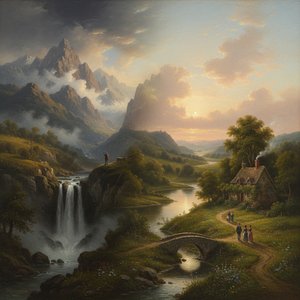
The “Dürer Series” is not simply about replicating the style of Albrecht Dürer. Wagner uses Dürer’s compositions as a springboard for exploring themes of nature, spirituality, and human existence. His landscapes are often imbued with a sense of melancholy and introspection, reminiscent of Caspar David Friedrich's iconic Romantic scenes. The portraits, while technically precise, possess an emotional depth that transcends mere representation.
Wagner masterfully blends realism with symbolism, layering meaning into every brushstroke and color choice. He frequently incorporates elements from other masters—Tintoretto’s dramatic lighting or the compositional balance of Renaissance painters—creating a rich tapestry of artistic influences. The series is characterized by a muted palette, dominated by earth tones and subtle gradations of light and shadow, which contribute to its overall atmosphere of quiet contemplation.
The works are not overtly narrative, but rather invite viewers to engage in their own interpretations, prompting reflection on the human condition and our relationship with the natural world.
Historical Significance and a Unique Legacy
Friedrich E. Wagner’s artistic legacy is still developing, as his work has primarily been known within a smaller circle of art enthusiasts and collectors. However, the “Dürer Series” represents a fascinating intersection of science and art—a testament to the power of interdisciplinary thinking and the enduring appeal of historical aesthetics. His ability to seamlessly blend technical precision with emotional depth sets him apart as a unique voice in contemporary art.
- Wagner’s work challenges conventional notions of artistic training, demonstrating that passion and intellectual curiosity can be powerful substitutes for formal education.
- The series offers a fresh perspective on the works of Albrecht Dürer, prompting viewers to reconsider these iconic images in new light.
- His exploration of German Romanticism provides a compelling commentary on themes of nature, spirituality, and human existence.
While celebrated for his scientific achievements, Friedrich E. Wagner’s artistic endeavors reveal a multifaceted individual—a physicist who found solace and inspiration in the world of art, leaving behind a body of work that is both intellectually stimulating and emotionally resonant. His story serves as a reminder that creativity knows no boundaries and that the pursuit of knowledge can take many unexpected forms.