A Quiet Observer of Rural Life: The World of Colin Graeme Roe
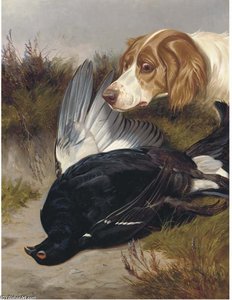
Colin Graeme Roe, born in the United Kingdom in 1858 and passing away in 1910, was a painter who dedicated his artistic life to capturing the serene beauty and subtle narratives of the British countryside. Though not widely celebrated during his lifetime, Roe’s work offers a compelling glimpse into Victorian rural life, imbued with a quiet realism and a palpable affection for the natural world. His paintings are characterized by their meticulous detail, harmonious color palettes, and an ability to evoke a sense of peaceful contemplation in the viewer. He wasn't painting grand historical scenes or portraits of societal elites; instead, Roe focused on the everyday rhythms of nature and the working lives intertwined with it – scenes of hunting parties, dogs at rest, and landscapes that breathe with authenticity.
Early Life and Artistic Development
Details regarding Roe’s formal artistic training remain somewhat elusive. However, his style suggests a strong grounding in traditional techniques, likely acquired through private lessons or studies within the established art circles of Victorian Britain. The influence of the Barbizon school is subtly present in his landscapes, particularly in his use of natural light and atmospheric perspective. He appears to have been drawn to the realism championed by artists like Jean-François Millet, though Roe’s work possesses a distinctly British sensibility – less focused on social commentary and more attuned to the picturesque qualities of the English countryside. His early works likely served as studies for larger compositions, honing his skills in animal anatomy and landscape rendering. The focus on sporting scenes—otter hounds, gundogs—suggests an environment where these activities were commonplace, perhaps within a landed estate or amongst a hunting-oriented social circle.
Themes and Techniques
Roe’s oeuvre is dominated by paintings depicting scenes of rural life, particularly those revolving around hunting and the companionship between humans and animals.
Otter hounds are a recurring motif, often portrayed in moments of rest or pursuit along woodland streams. His depictions of dogs—gundogs, terriers—are rendered with remarkable accuracy and sensitivity, capturing their alertness, intelligence, and inherent grace. Beyond the animal subjects, Roe’s landscapes are equally compelling. He masterfully portrays the changing seasons, the play of light on water, and the textures of foliage.
His technique is characterized by a smooth application of oil paint, creating a sense of depth and realism. The color palettes are typically muted—earthy browns, greens, and grays—reflecting the natural tones of the British countryside. He avoids dramatic contrasts, instead favoring subtle gradations of tone to create atmospheric effects.
Legacy and Historical Significance
While Colin Graeme Roe did not achieve widespread fame during his lifetime, his paintings have experienced a resurgence in popularity in recent years. His work offers a valuable insight into the Victorian era’s relationship with nature and rural life. He provides a counterpoint to the more industrialized and urbanized aspects of the period, reminding us of the enduring appeal of the countryside as a source of beauty, tranquility, and spiritual renewal.
- His paintings are appreciated for their technical skill and meticulous detail.
- Roe’s work provides a glimpse into Victorian sporting culture.
- He captures the essence of rural life with sensitivity and authenticity.
Today, his art is sought after by collectors who appreciate its serene aesthetic and historical significance. His paintings serve as a testament to the enduring power of observation and the beauty that can be found in the everyday moments of life. He remains an important figure for those interested in Victorian landscape painting and the artistic representation of the natural world.