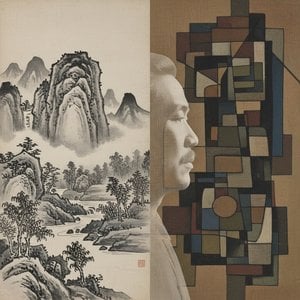
A Life Immersed in the Diamond Mountains
Byeon Gwansik, also known by his art name Sojeong (1899-1976), stands as a pivotal figure in 20th-century Korean painting. Born in Seoul during a period of immense social and political upheaval, Byeon’s life was inextricably linked to the evolving artistic landscape of Korea—a journey marked by both adherence to tradition and a bold embrace of modernity. He wasn't merely a painter; he was a chronicler of his nation’s spirit, deeply connected to its natural beauty, particularly the majestic Diamond Mountains.
Early Life and Artistic Foundations
Byeon Gwansik’s early life laid the groundwork for his lifelong dedication to art. Orphaned at a young age, he was raised by his maternal grandmother, Cho Seok-jin, a prominent painter of the late Joseon Dynasty. This upbringing proved formative, immersing him in the world of ink and brush from childhood. He entered the Seohwa Art Center in 1917, founded by An Jung-sik, where he received rigorous training in traditional Korean painting techniques. These early years instilled in him a profound respect for the masters—Jeong Seon and Kim Hongdo—whose influence would resonate throughout his career.
The Pursuit of Modernity and a Unique Style
Following his formal education, Byeon embarked on a path that blended tradition with innovation. He joined Dongyeonsa in 1922, a group dedicated to artistic exploration, and later spent four years studying at the Tokyo Art School. This exposure to Japanese art trends introduced him to *Shinnamhwa*, a new wave of oriental painting gaining popularity. However, Byeon didn’t simply adopt these foreign influences; he synthesized them with his existing knowledge, forging a distinctive style characterized by its realistic depiction of nature and dynamic brushwork. He moved away from the purely decorative aspects of traditional landscape painting, seeking to capture the essence and spirit of the Korean countryside.
The Diamond Mountains as Muse
Byeon Gwansik’s artistic identity became inextricably linked with the Diamond Mountains (Geumgangsan). Throughout his lifetime, he made multiple visits to this celebrated site, captivated by its breathtaking beauty. The mountains weren't just a subject for him; they were a source of spiritual inspiration and national pride. His paintings of Geumgangsan—such as ‘Autumn Colors of Samseonam Rocks in Outer Geumgang’ (1966)—are not mere representations of the landscape but rather evocative interpretations that convey its grandeur, serenity, and emotional power. He captured the mountains in all seasons, under varying weather conditions, revealing a deep understanding of light, shadow, and atmospheric perspective.
Legacy and Historical Significance
Byeon Gwansik is widely regarded as one of the two monumental figures in the history of modern Korean art, alongside Lee Sangbeom. While both artists succeeded the tradition of Jeong Seon and Kim Hongdo, they approached it from different angles. Byeon’s work represents a unique synthesis of traditional techniques and modern sensibilities, establishing him as a pioneer of Korean landscape painting. His paintings not only captured the beauty of Korea's natural landscapes but also reflected the nation’s cultural identity during a period of significant change. He left behind a legacy that continues to inspire artists today, reminding them of the importance of preserving tradition while embracing innovation.