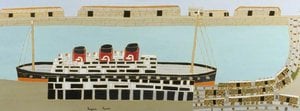
Walter Bryan Pearce (1927 – 2007) was a British painter recognized as one of the UK’s leading naïve artists, capturing the essence of Cornwall and its daily life with distinctive bold outlines and vibrant hues. Born in St Ives, Cornwall, his artistic journey began under the nurturing influence of his mother, Mary Warmington—herself a painter—and later fostered by fellow St Ives artists like Peter Lanyon. Pearce’s formative years were marked by congenital phenylketonuria (PKU), which necessitated special schooling and profoundly shaped his perception of the world, imbuing his art with an unparalleled sensitivity to observation.
Early Influences: Mary Warmington's artistic passion instilled in Pearce a deep appreciation for visual expression from a young age.
Formal Training: He attended Leonard Fuller’s St Ives School of Painting (1953-1957), honing his skills and developing his distinctive style.
Pearce's artistic technique revolved around a strikingly simple approach—flat canvases dominated by bold outlines surrounding areas of intense color, reminiscent of stained glass windows. This method wasn’t merely stylistic; it reflected Lanyon’s assertion that Pearce’s art communicated “awareness more direct” than pure visual representation. He described Pearce’s work as "original," emphasizing the artist's ability to convey experience beyond conventional perception. Comparisons with Alfred Wallis, another St Ives painter known for his reductive style and evocative landscapes, further illuminate Pearce’s artistic lineage.
Style Characteristics: Bold outlines juxtaposed with vibrant color palettes created a visual impact akin to stained glass.
Philosophical Approach: Lanyon's commentary underscored Pearce’s commitment to conveying experience authentically, prioritizing emotional resonance over meticulous detail.
Joining the Penwith Society of Arts in 1957 and subsequently the Newlyn Society of Artists propelled Pearce’s artistic career forward. His debut solo exhibition at the Newlyn Gallery in 1959 garnered critical acclaim, followed by a London showcase at St Martin's Gallery in 1962. Retrospectives spanning from 1966 to 2004 celebrated his enduring legacy, notably exhibitions at Penwith Gallery (1966), the Museum of Modern Art Oxford (1975), the Royal Cornwall Museum Truro (2000), and Victoria Art Gallery Bath (2004). His paintings are now held in numerous public collections across Britain.
Notable Exhibitions: Solo exhibitions at St Martin’s Gallery and Penwith Gallery cemented Pearce's reputation as a prominent figure in British art.
Collection Presence: His artwork resides in prestigious museums nationwide, ensuring its continued appreciation for generations to come.
Pearce’s oeuvre predominantly focused on landscapes of Cornwall—particularly St Ives Harbour and “The Queen Mary”—executed with unwavering dedication to capturing the spirit of his surroundings. These paintings are celebrated for their luminous color palettes and expressive contours, embodying a unique vision that transcends mere representation. Pearce's contribution to naïve art is significant, securing his place as an artist who successfully translated sensory experience into emotionally resonant visual narratives.
Uredništvo WahooArt.com
Kviz o umjetnosti
Svako pitanje ima samo jedan točan odgovor.
Pitanje 1:
Where was Bryan Pearce born?
Pitanje 2:
What condition did Bryan Pearce suffer from?
Pitanje 3:
Bryan Pearce attended which school of painting?
Pitanje 4:
Who praised Bryan Pearce’s art style, describing it as ‘awareness more direct’?
Pitanje 5:
Bryan Pearce specialized in painting what subject matter?
Otkrijte 10 remek-djela romantizma koja su definirala pejzažno slikarstvo! Uronite u svijet Friedricha, Turnera i Aivazovskog. Inspirirajte svoj interijer vrhunskim umjetničkim djelima. Kupujte reprodukcije na WahooArt.com!
Explore the life & work of Alfred East, a pioneer of British plein air painting. Discover his techniques for capturing atmospheric landscapes, Barbizon influences, and lasting legacy. Learn more at WahooArt.
Uronite u svijet John Constabla! Otkrijte 25 remek-djela engleskog romantizma i pejzaža. Ekskluzivne reprodukcije slika, zidna dekoracija & inspiracija za dizajn interijera na WahooArt.com. Istražite cijelu kolekciju online!