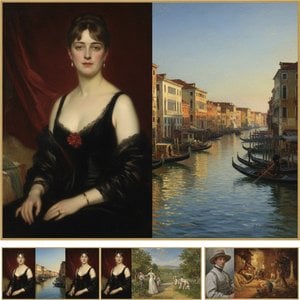
The Luminous Legacy of Arthur John Black
In the grand tapestry of British art history, certain names shine with a blinding brilliance, while others provide the essential, delicate threads that give the work its depth and texture. Arthur John Black (1855–1936) belongs to that profound second category—a master whose meticulous observation of the natural world and command over light offered a window into the soul of the British landscape. Though often overshadowed by the monumental figures of the Victorian and Edwardian eras, Black’s work possesses an intimate, breathing quality that captures the ephemeral beauty of rural life with unparalleled grace. His journey as an artist was one of constant refinement, moving from the rugged, spiritual landscapes of his Scottish youth to the sophisticated, light-drenched scenes of the English countryside.
Born in 1855, Black’s artistic sensibilities were forged in the breathtaking scenery of Perthshire, Scotland. The Highlands, with their dramatic vistas and shifting atmospheres, served as his first great teacher. This early immersion in nature was further refined through rigorous academic training; he studied at the Glasgow School of Art under the legendary John Ruskin. From Ruskin, Black inherited a profound belief in the moral weight of landscape painting—the idea that to depict nature with absolute truth is to honor a spiritual reality. This commitment to precision and essence was later bolstered by his time in Paris, where he studied at the Academie des Beaux Arts under the esteemed Benjamin Constant. This unique blend of Scottish Romanticism and French academic discipline allowed Black to develop a style that was simultaneously grounded in realism and elevated by an almost poetic luminosity.
A Master of Light and Medium
While many of his contemporaries sought the heavy, dramatic permanence of oil, Black found his truest voice in the delicate, translucent world of watercolor. He approached the medium not merely as a tool for sketching, but as a way to capture the very breath of the atmosphere. Through masterful layering and subtle washes, he achieved a level of depth and radiance that few could replicate. His canvases do not simply show a landscape; they evoke the dampness of a morning mist, the warmth of a setting sun, and the fleeting shimmer of light through autumn leaves. This technical prowess extended to his oil paintings as well, where he applied his keen eye for detail to create portraits and landscapes that possessed a remarkable structural integrity.
His repertoire was remarkably diverse, reflecting a life spent observing the quiet rhythms of the earth:
- Scottish Landscapes: Evocative depictions of his native Highlands, imbued with the ruggedness and spiritual gravity learned from Ruskin.
- Rural English Scenes: Pastoral studies that captured the charm and industriousness of the English countryside, often featuring themes of haymaking and seasonal change.
- Portraiture: Intimate character studies, such as his delicate rendering of Mrs. Mary E. Pennel, which showcased his ability to capture human dignity through light and texture.
- Atmospheric Studies: Works like Ocean's Laughter and In the Track of the Sun, where the subject is not a place, but the movement of light itself.
Recognition and Enduring Significance
Throughout his prolific career, Black was a highly respected figure within the professional art community. His frequent exhibitions at the Royal Academy—totaling some thirty-six occasions—and his fifty-four appearances at the Royal Institute of Oil Painters speak to a level of sustained excellence and peer recognition. As a member of both the New Society of Painters in Watercolours and the Royal Institute of Painters in Oil, he stood at the intersection of different artistic movements, bridging the gap between traditional realism and the burgeoning Impressionistic influences of his time.
As the decades progressed, Black’s life took him from the vibrant art hubs of London and Nottingham to the quietude of Dorset, where he remained until his death in 1936. Today, his legacy lives on in the collections of prestigious institutions such as the Castle Museum & Gallery in Nottingham and the Gurnsey Museum of Art. To look upon a painting by Arthur John Black is to experience a moment of stillness; it is an invitation to pause and witness the quiet majesty of a world that, while passing, remains eternally captured in his luminous strokes.