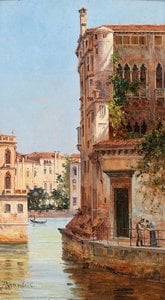
A Venetian Light: The Life and Art of Antonietta Brandeis
Antonietta Brandeis, a name perhaps less familiar than those of her celebrated contemporaries, nevertheless represents a compelling story of artistic ambition and achievement in 19th-century Italy. Born Antonie Brandeisová in the Bohemian village of Miskovice in 1848, her journey was one marked by both privilege – access to education uncommon for women of her time – and pragmatic adaptation within a male-dominated art world. The early loss of her father prompted a relocation with her mother, eventually leading them to Prague where Antonietta received foundational training from Karel Javůrek. This initial exposure instilled in her the principles of academic painting, laying the groundwork for a style that would later blossom under the unique light and atmosphere of Venice. It was this move to Venice, however, that truly defined her artistic trajectory. Enrolling at the prestigious Venetian Academy of Fine Arts in 1867, she became one of the first women to receive formal instruction there, navigating a challenging landscape with determination and talent.Forging a Path: Education and Early Influences
The Venetian Academy proved pivotal. Brandeis excelled, earning accolades in disciplines ranging from perspective and life drawing to landscape and art history – skills honed under the tutelage of esteemed professors like Michelangelo Grigoletti, Domenico Bresolin, Napoleone Nani, and Federico Moja. This rigorous training wasn’t merely technical; it immersed her in a rich artistic heritage. Venice itself was a living museum, steeped in the tradition of the *vedutisti* – artists celebrated for their detailed views of the city. Canaletto and Guardi cast a long shadow, and Brandeis absorbed their meticulous approach to capturing architectural precision alongside the atmospheric nuances of light and water. However, her education wasn’t solely confined to Italian masters; Javůrek's influence likely introduced her to currents in European Romanticism and Realism circulating at the time. This blend of influences would become a hallmark of her work – a commitment to realistic detail tempered by a sensitivity to mood and atmosphere. A fascinating aspect of Brandeis’ career is her decision, later on, to exhibit under the name “Antonio.” This wasn't a rejection of her identity, but rather a calculated move to circumvent potential prejudice, hoping that her art would be judged solely on its merits, free from gendered expectations.Venetian Visions: Style and Subject Matter
Brandeis’s artistic output centered primarily around Venetian scenes – the iconic canals, grand palazzos, bustling piazzas, and intimate glimpses of daily life. She became a master of the *veduta*, yet her approach wasn't simply replication. While she often revisited popular subjects, offering variations on familiar themes, she infused each canvas with her own distinctive touch. Her paintings are characterized by an intricate level of detail, a luminous color palette that captures the unique quality of Venetian light, and a keen eye for atmospheric perspective. She didn’t merely paint buildings; she painted the *feeling* of Venice – the shimmering reflections on the water, the warmth of the sun-drenched stone, the vibrant energy of the city. Beyond her celebrated views of Venice, Brandeis also explored genre painting, portraiture, and religious subjects, demonstrating a versatility that further solidified her reputation as a skilled and accomplished artist. Her altarpieces for the island of Korcula in Croatia, including a Madonna with Christ Child and copies of works by Giovanni Bellini, attest to her ability to handle larger-scale commissions and demonstrate reverence for established artistic traditions.Recognition and Legacy: A Pioneer’s Place in History
Throughout her career, Antonietta Brandeis exhibited widely across Europe – Venice, Florence, Budapest, Melbourne, Turin, Milan, and Rome all hosted showings of her work. Her paintings were particularly sought after by tourists undertaking the Grand Tour, eager to acquire a tangible memento of their Venetian experience. The sale of “Palazzo, Marin Falier” to M. Hall of London in 1875 for 320 lire was an early indication of her growing success and appeal to international collectors. While she may not enjoy the same level of widespread recognition as some of her male contemporaries, Brandeis’s significance lies in her pioneering role as a woman artist navigating a challenging professional landscape. Her acceptance into the Venetian Academy, her consistent exhibition record, and her commercial success all demonstrate her talent, resilience, and determination. She stands as a testament to the artistic contributions of women often overlooked by traditional art historical narratives. Today, her paintings offer valuable insights into 19th-century Venetian life and culture, capturing not just the physical beauty of the city but also its unique atmosphere and enduring allure. Her legacy continues to inspire, reminding us of the power of art to transcend boundaries and illuminate the human experience.- Born: January 13, 1848, Miskovice (near Kutná Hora), Bohemia (now Czech Republic)
- Died: March 20, 1926
- Style: Detailed, luminous, influenced by the *vedutisti* tradition.
- Subject Matter: Venetian scenes (*vedute*), landscapes, genre paintings, portraits, and religious subjects.
Pitanja i odgovori
Mogu li pregledavati djela umjetnika Antonietta Brandeis prema paleti boja?
Stranica Prema paletama boja grupirala je djela umjetnika Antonietta Brandeis prema njihovim paletama boja.
Koje je boje Antonietta Brandeis najčešće koristio/la?
Profil boja u radovima umjetnika Antonietta Brandeis možete pogledati na njegovoj stranici Genom palete.
Gdje se djela umjetnika Antonietta Brandeis mogu pronaći organizirana prema boji?
Stranica Spektar boja organizira djela umjetnika Antonietta Brandeis prema boji.