Biography
Ziyi Xia, born in Chongqing, China (1993), is a Chinese artist whose distinctive style blends the precision of engineering principles with the intricate beauty of woodcut prints—a fusion that reflects her academic background and artistic vision. Her journey began in Chongqing where she pursued a Bachelor’s degree in Automation from Nanjing University of Aeronautics and Astronautics in 2016, equipping her with analytical skills crucial for understanding form and structure within her artwork. Currently enrolled in pursuit of an MSc in Control Theory and Control Engineering at Chongqing University's College of Automation, Xia continues to hone her expertise while simultaneously exploring artistic expression—a testament to the enduring power of intellectual curiosity alongside creative passion.
Xia’s formative years were imbued with a profound appreciation for art fostered by her father, Zhang Zimei, who served as a teacher and instilled in her a deep connection to Chinese heritage. She excelled academically, securing admission to Puyang County Central Primary School followed by Nanjing Jun Yi Middle School—institutions that recognized her exceptional talent from an early age. This dedication to learning laid the foundation for her artistic pursuits, shaping her perspective on both scientific inquiry and creative exploration.
Recognizing her innate aptitude for visual arts, Xia enrolled in the National College of Art in Hangzhou where she studied under esteemed masters like Huang Binhong and Zhu Qizhan—figures who championed traditional Chinese painting techniques alongside figure sketching and oil painting methods. This immersive experience solidified her understanding of artistic composition and execution, grounding her creative endeavors in established artistic traditions. The influence of Wang Hui, a Qing Dynasty artist renowned for his elegance and dedication to portraying landscapes with breathtaking accuracy, further enriched Xia’s artistic sensibilities.
Xia's professional career began at the Shanghai People’s Publishing House where she collaborated on comic strip projects with Chen Fuping—a partnership that broadened her artistic repertoire beyond solo endeavors and exposed her to diverse storytelling approaches. This experience honed her ability to communicate complex ideas through visual mediums, demonstrating adaptability and a willingness to embrace collaborative creativity. Notably, Xia's work gained recognition within the scientific community, appearing on IEEE Xplore, a leading platform for scholarly literature—a remarkable achievement that underscores the intersection between STEM disciplines and artistic expression. Her prints have been showcased in exhibitions celebrating contemporary prints and abstract woodblock designs—reflecting her engagement with evolving trends in visual art and cementing her position as a rising voice within the field.
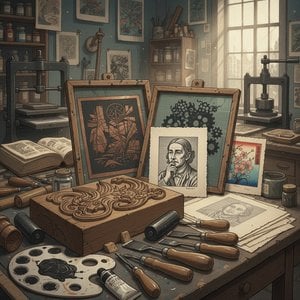
Xia’s artwork is fundamentally driven by mathematical concepts – an intentional juxtaposition that underscores her belief in harnessing logic to elevate aesthetic experience. Her prints aren't merely decorative; they are explorations of geometric forms and spatial relationships, mirroring the structured thinking developed during her engineering studies. The process itself—carving lines into wood blocks before applying ink—represents a deliberate connection to traditional craftsmanship while simultaneously embracing modern analytical methods. This fusion reflects Xia’s artistic philosophy: transforming theoretical understanding into tangible visual forms. Her prints explore themes of form, structure, and balance, mirroring the principles of engineering design – an approach that distinguishes her work from many others in contemporary art. She was honored as an author in the field of engineering, highlighting the remarkable ability to synthesize knowledge across disciplines and fostering a dialogue between STEM fields and artistic creativity.
Xia’s contribution to Chinese art history lies in her pioneering blend of technical precision and aesthetic vision—a synthesis that challenges conventional notions of artistic practice. Her exploration of geometric forms speaks to broader discussions about visual representation and mathematical abstraction in art history, demonstrating Xia's commitment to intellectual rigor alongside artistic passion. By combining engineering expertise with artistic creativity, she embodies the spirit of innovation within Chinese art – a legacy destined to inspire future generations of artists and thinkers.