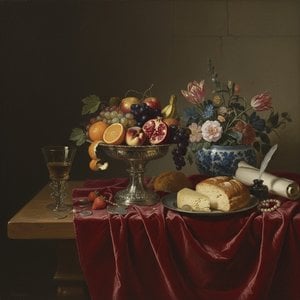
La rêverie silencieuse d'un peintre : La vie et l'héritage de Xavier Valls
L'art de Xavier Valls (1923–2006) s'offre comme une méditation profonde sur la beauté nichée dans le calme de l'existence quotidienne. Né à Barcelone le 18 septembre 1923, le parcours artistique de Valls fut façonné par une confluence unique entre ses racines espagnoles et le raffinement parisien. Ses premières années furent marquées par une formation fondamentale rigoure susceptible d'influencer son œuvre, sous la direction de figures marquantes telles que le sculpteur Charles Collet et le peintre Jaume Busquets. Cette période formative des années 1930, caractérisée par d'importants échanges culturels entre l'Espagne et la Suisse, lui a inculqué un profond respect pour les principes visuels qui allaient plus tard définir son style mature. Ses premières explorations du dessin et des techniques décoratives, incluant la peinture murale et le vitrail, lui ont doté d'un vocabulaire technique polyvalent, lui permettant d'aborder la toile avec une précision structurelle doublée d'une grande liberté expressive.
Au fil de sa carrière, Valls s'est dirigé vers le cœur vibrant de la scène artistique européenne en s'établissant à Paris. Cette résidence fut bien plus qu'un simple changement de décor ; ce fut une ère charnière d'expansion intellectuelle et artistique. En 1946, aux côtés de collègues tels que Suzanne Alemany et Alfred Figueras, il cofonde le Cercle Maillol à l'Institut Français de Barcelone, témoignant d'un engagement précoce pour la promotion du dialogue artistique communautaire. Son séjour à Paris lui a permis de s'imprégner profondément des traditions européennes, absorbant les nuances de l'avant-garde française tout en maintenant un lien indéfectible avec son héritage catalan. Cette période de croissance fut enrichie par des collaborations avec des architectes et designers de renom, tels que Santiago Marco et Luís Bonet Garí, qui ont élargi sa compréhension de l'espace, de la lumière et de la forme au-delà des limites du cadre traditionnel.
Maîtrise de la lumière, de la texture et de l'immobilité
L'œuvre de Valls est surtout célébrée pour sa maîtrise captivante des natures mortes et des paysages, genres à travers lesquels il a exploré le jeu entre la lumière et la texture. Son travail possède souvent une dignité introspective et silencieuse, obtenue grâce à un usage sophistiqué de la couleur et du coup de pinceau. Dans ses portraits, on peut observer un mélange subtil de réalisme et d'influence cubiste, où des tons bruns feutrés et un impasto texturé créent une atmosphère de profonde contemplation. Ses natures mortes, mettant en scène des céramiques, des figues ou de simples théières, évoquent fréquemment l'intemporalité des Maîtres Hollandais, utilisant une approche classique pour capturer l'essence tactile des objets. Qu'il s'agisse de dépeindre les paysages luxuriants de France et d'Espagne ou l'arrangement intime de fruits sur une table, Valls possédait une capacité singulière à élever le banal au rang de monumental.
L'évolution technique de son travail est jalonnée par plusieurs étapes clés :
- Les fondations initiales : Une période d'apprentissage des arts décoratifs, du vitrail et du dessin sous l'égide de maîtres comme Charles Collet.
- <Engagement avant-gardiste : Son émergence dans les années 1950 au Salon d'Automne, où son talent pour fusionner le réalisme avec les influences modernes a acquis une reconnaissance internationale.
- <Esprit collaboratif : Un travail aux côtés de figures telles que Fernand Léger sur des conceptions de vitraux, jetant un pont entre les beaux-arts et le design appliqué.
- <Reconnaissance mature : L'obtention de distinctions prestigieuses comme le Prix Drouant en 1980 et des expositions monographiques dans des institutions estimées telles que le Musée Ingres.
Signification historique et influence durable
La portée historique de Xavier Valls réside dans sa capacité à naviguer à travers les complexités des mouvements artistiques mouvants du XXe siècle sans jamais perdre sa voix unique et habitée. Alors que nombre de ses contemporains s'orientaient vers l'abstraction totale, Valls est resté ancré dans un réalisme raffiné qui célébrait le monde tangible. Son œuvre se dresse comme un pont entre les traditions classiques du passé et l'esprit expérimental de l'ère moderne. L'inclusion de ses pièces, telles que Pêches et Pichet, dans des collections permanentes comme le Museo de Arte Moderno à Madrid garantit que sa contribution aux arts espagnol et français demeure préservée pour les générations futures.
Au-delà de ses accomplissements individuels, la vie de Valls s'est inscrite dans une tapisserie culturelle plus vaste. En tant que père de la figure politique emblématique Manuel Valls, son histoire personnelle croise souvent le discours politique moderne, pourtant son héritage artistique demeure purement esthétique et émotif. Il laisse derrière lui un corpus d'œuvres qui invite le spectateur à ralentir, à observer les subtiles gradations de la lumière sur une surface de céramique, et à trouver la beauté dans les moments silencieux et inobservés de la vie. Ses peintures continuent de résonner dans les galeries et musées du monde entier, témoignant de la puissance éternelle du regard pictural.
Questions et réponses
Où puis-je voir les œuvres de Xavier Valls classées par atmosphère ?
Les œuvres de Xavier Valls peuvent être parcourues par émotion sur la page L'ambiance par émotion de l'artiste, qui organise les œuvres d'art selon l'ambiance qu'elles dégagent.
À quelle période historique Xavier Valls a-t-il exercé ?
Xavier Valls a œuvré durant la période Époque moderne. Cette période situe l'activité de l'artiste dans l'histoire.
Comment l'art de Xavier Valls a-t-il évolué au fil du temps ?
La Chronologie de Xavier Valls est une frise chronologique interactive qui présente les œuvres de l'artiste par ordre chronologique, regroupées en chapitres correspondant aux différentes périodes de sa carrière.