Wu Shanming: A Master of Tranquil Lineage
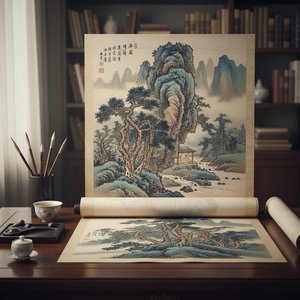
Wu Shanming (born 1941 in Putian, China) stands as a prominent figure within the realm of Chinese ink wash painting—a tradition steeped in centuries of artistic refinement and philosophical contemplation. His distinctive style centers on meticulously rendered depictions of figures adorned in traditional garments, capturing not merely likeness but embodying an essence of timeless beauty and cultural heritage.
Early Life & Education
Born in Pujiang County, Wu Shanming’s formative years were marked by a profound dedication to artistic pursuits from a young age. Recognizing his innate talent for visual expression, he pursued his undergraduate studies at the China Academy of Fine Arts in Hangzhou—a pivotal step establishing a foundational understanding of classical Chinese painting principles and techniques. This immersive experience instilled within him an unwavering commitment to mastering the fundamental elements of traditional art forms—a dedication that would shape his artistic trajectory throughout his life’s journey.
Formal Training & Artistic Influences
Continuing his academic exploration, Wu Shanming honed his skills further at the Art Institute of Chicago, earning an MFA in Printmaking—a discipline that profoundly broadened his visual vocabulary and deepened his engagement with Western art traditions alongside the enduring legacy of Chinese calligraphy and painting. The influence of Impressionism and Fauvism particularly resonated within him—inspiring a stylistic approach characterized by vibrant color palettes and expressive brushstrokes—a testament to his intellectual curiosity and willingness to synthesize diverse artistic perspectives.
Signature Style: The Delicate Dance of Line
Wu Shanming’s hallmark is undeniably his masterful execution of ink wash technique—a method revered for its ability to convey subtle nuances of emotion and movement through delicate lines interwoven in complex patterns. As he eloquently stated, “Artists need to integrate our own life experience and emotions into a perfect form through certain media.” This meticulous process mirrors the painstaking care required in lacquer production—reflecting Wu Shanming’s unwavering belief in precision and attention to detail. The resulting artworks possess an ethereal quality—capturing not just visual representation but conveying a deeper sense of contemplative harmony.
Recurring Themes & Symbolism: Echoes of Kunqu Opera
Wu Shanming's oeuvre consistently explores themes rooted in Chinese culture—most notably references to Kunqu Opera—a celebrated genre of Chinese opera renowned for its lyrical melodies and intricate rhythms. He perceives parallels between the musical elements of Kunqu Opera and the visual forms of his paintings—suggesting a harmonious dialogue between art and music that transcends temporal boundaries. These symbolic representations serve as reminders of China’s rich artistic heritage—affirming Wu Shanming's commitment to honoring tradition while simultaneously pushing creative boundaries.
Recent Exhibitions & Recognition: A Global Voice
Wu Shanming’s artistic vision has garnered international acclaim through numerous exhibitions across Asia and North America—including presentations at institutions such as the National Art Museum of China in Beijing; OCAT Contemporary Art Terminal in Shenzhen; Boxes Art Museum in Shunde, China; The Snite Museum of Art in Indiana, United States. His work continues to resonate with audiences worldwide—cementing his place as a significant contributor to contemporary Chinese art and establishing him as one of the foremost practitioners of ink wash painting in our time. He has been honored by prestigious awards recognizing his artistic excellence and furthering his contribution to the global art community.