Wu Guxiang (1848–1903): The Poet Painter of Tranquility
Wu Guxiang (吳穀祥), born in Jiangsu Province, China, was a pivotal figure in the late Qing Dynasty’s artistic landscape. He emerged as a prominent Shanshui painter—a genre emphasizing idealized depictions of mountainous landscapes—whose work embodies both meticulous technique and profound philosophical contemplation. His art reflects the spirit of Neo-Confucianism, prioritizing harmony with nature and inner reflection alongside masterful brushwork.- Early Life & Education: Guxiang’s formative years were marked by a rigorous Confucian upbringing, instilled in him by his father, who recognized his artistic talent early on. He studied calligraphy and painting under renowned masters, honing his skills and absorbing the aesthetic principles of traditional Chinese art.
- Influences: His artistic vision was deeply impacted by Tang Dynasty landscape painters like Wang Wei and Guo Xi, whose serene depictions of mountains and rivers served as models for Guxiang’s compositions. Furthermore, he embraced Zen Buddhism's emphasis on simplicity and mindfulness, translating into a restrained palette and understated brushstrokes.
The Art of Shanshui: Technique & Symbolism
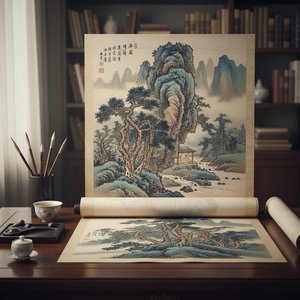
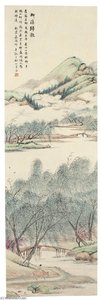
Guxiang’s Shanshui paintings are characterized by exceptional mastery of ink wash technique—known as Guan hua qi shi. He skillfully employed layering, hatching, and blending to create textures that capture the misty grandeur of mountainous terrains. Beyond mere representation, his works convey deeper meanings rooted in Confucian cosmology. Pine trees, often depicted prominently, symbolize longevity and resilience – enduring symbols of virtue and spiritual fortitude. Waterfalls represent purity and transformation, mirroring the Buddhist concept of overcoming obstacles on the path to enlightenment.- Notable Paintings: Among his most celebrated pieces are “Pines in the Misty Mountains,” “Plum Blossoms in Spring,” and “Studio Amidst Pine Grove.” These paintings exemplify Guxiang’s ability to distill complex philosophical ideas into visually arresting landscapes. They showcase a remarkable sensitivity to light, color, and atmospheric perspective.
- Critical Reception: Contemporary critics lauded Guxiang's work for its aesthetic beauty and intellectual depth. He was recognized as one of the foremost Shanshui painters of his era, securing a place among the giants of Chinese art history.
Legacy & Historical Significance
Wu Guxiang’s influence extended far beyond his lifetime. His paintings continue to inspire artists and scholars alike, serving as benchmarks for Shanshui aesthetics. He championed a contemplative approach to artistic creation—emphasizing inner harmony and spiritual awareness alongside technical virtuosity. As a symbol of Neo-Confucian ideals embodied in visual art, Guxiang’s oeuvre remains an enduring testament to China's cultural heritage and its profound engagement with the natural world.- Continuing Influence: His stylistic innovations—particularly his use of subtle color gradations—influenced subsequent generations of painters. He solidified Shanshui painting as a genre dedicated to conveying moral and spiritual truths alongside visual splendor.