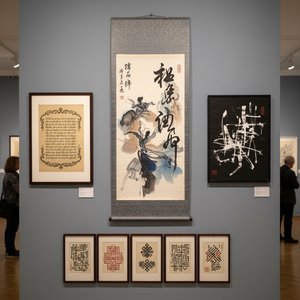
Wu Changshuo : Entre Calligraphie et Paysage – Un Héritage de Sérénité
Wu Changshuo (吳昌碩; 1844-1927), né sous le nom de Wu Junqing, s'impose comme une figure charnière de l'art chinois de la fin de la dynastie Qing. Il est principalement célébré pour sa fusion magistrale entre la calligraphie et la peinture de paysage, une technique qui a profondément façonné les sensibilités esthétiques de son époque et continue d'inspirer les artistes contemporains. Né à Zhuzhou, dans la province du Zhejiang, le voyage artistique de Wu a débuté au cœur de la ferveur intellectuelle de sa famille, cultivant dès son plus jeune âge un amour pour les quêtes érudites et la puissance expressive du langage écrit.
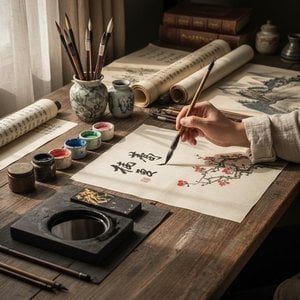
- Influences précoces et formation à la calligraphie : Les années de formation de Wu furent marquées par un entraînement rigoureux à la calligraphie, se concentrant spécifiquement sur les écritures anciennes telles que le Xiao Shu (小學). Cette discipline lui a inculqué une compréhension profonde du travail au pinceau, de la composition et de l'harmonie tonale — des principes qui allaient imprégner l'ensemble de ses futures entreprises artistiques.
- Installation à Suzhou et service impérial : Conscient de l'importance de l'environnement pour l'épanouissement créatif, Wu s'installa à Suzhou, dans la province du Jiangsu, où il s'établit comme un artiste et érudit respecté. Il servit brièvement comme fonctionnaire impérial au Liaoning durant les dernières années de la dynastie Qing, acquérant une expérience inestimable dans l'art de naviguer les complexités du mécénat de la cour.
La percée artistique de Wu Changshuo survint dans la trentaine, lorsqu'il s'engagea dans une exploration soutenue de la peinture de paysage, un genre qui connaissait alors une renaissance après des siècles de déclin. Contraquirement à nombre de ses contemporains qui s'enchaîna et aux conventions rigides, Wu prôna une approche distinctive caractérisée par la spontanéité et la résonance émotionnelle. Il évitait délibérément le détail méticuleux, privilégiant plutôt la transmission d'une humeur et d'une atmosphère à travers des coups de pinceau subtils et des variations tonales. Cette préférence stylistique l'aligna directement avec l'essor du mouvement de l'École de Shanghai, qui cherchait à libérer la peinture des contraintes académiques pour embrasser la liberté expressive.
- L'École de Shanghai et la peinture d'oiseaux et de fleurs : L'engagement de Wu Changshuo à capturer l'essence de la nature — particulièrement les fleurs et les oiseaux — devint sa marque de fabrique. Il étudia méticuleusement l'anatomie aviaire et la morphologie florale, traduisant l'observation scientifique en des représentations artistiques époustouflantes. Ses peintures sont renommées pour leurs palettes de couleurs lumineuses et leurs techniques de rendu délicates, reflétant une connexion profonde avec le monde naturel.
- L'art du sceau et philosophie artistique : Wu Changshuo considérait la calligraphie et la gravure de sceaux comme des disciplines inséparables, chacune enrichissant l'autre. Il fonda la Société d'Art du Sceau Xiling, favorisant la collaboration entre les graveurs de sceaux basés à Suzhou et promouvant une vision esthétique partagée. Ses sceaux se caractérisent par une élégante simplicité et une beauté sobre, incarnant sa conviction que l'expression artistique doit être guidée par la contemplation et l'harmonie.
Reconnaissance et Héritage
Le talent exceptionnel de Wu Changshuo lui valut une immense renommée, tant sur le plan national qu'international. Son admiration en faveur du Japon fut particulièrement notable, où ses peintures furent reconnues comme des chefs-d'œuvre de l'art paysager chinois — un témoignage de l'influence durable de sa vision artistique. Son œuvre continue de résonner auprès des publics d'aujourd'hui, servant d'exemple d'innovation stylistique et de profondeur émotionnelle dans le contexte plus large de l'histoire de l'art de la dynastie Qing. Il demeure une figure fondamentale pour comprendre l'évolution de la peinture chinoise et son lien profond avec les idéaux philosophiques.
- Œuvres notables : Parmi les peintures célèbres de Wu Changshuo figurent « Préparation du thé », « Le fruit de pêcher de trois mille ans » et « Offrandes printanières » — chacune démontrant sa maîtrise de l'harmonie tonale et du pinceau expressif. Ces pièces illustrent parfaitement l'éthos de l'École de Shanghai : capturer les moments éphémères de beauté et transmettre des états émotionnels profonds.
Pour aller plus loin
Pour une compréhension plus approfondie des contributions artistiques de Wu Changshuo, il est pertinent d'examiner son influence sur les générations suivantes de peintres chinois — notamment Qi Baishi (漆白石), qui adopta les principes stylistiques de Wu et se fit le champion de la beauté lyrique. Explorez également Pan Tianshou (潘天壽), un autre artiste influent dont l'œuvre embrassa, de manière similaire, la spontanéité et la résonance émotionnelle.