Woo Jae Gil: A Journey Through Geometric Abstraction
Born in Kyoto, Japan (1942), Woo Jae Gil embodies the spirit of a Korean artist navigating the complexities of modern art history while honoring profound cultural roots. His artistic trajectory began during a transformative period—the liberation from colonial rule—leaving an indelible mark on his worldview and fueling his dedication to exploring the dialogue between tradition and innovation.
Artistic Style and Themes
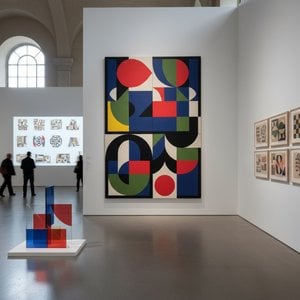
Woo Jae Gil’s distinctive visual language centers around geometric abstraction, primarily expressed through vibrant oil paintings and mixed media techniques. This stylistic choice isn't merely aesthetic; it represents a deliberate engagement with Western artistic principles championed by luminaries like Piet Mondrian and Josef Albers—a synthesis that elevates his work beyond regional boundaries. The resulting compositions prioritize fundamental shapes, lines, and forms, harmoniously balanced to evoke serenity and contemplation. Bold color palettes—often juxtaposed in unexpected ways—further amplify the emotional impact of his paintings, while subtle references to Asian iconography subtly enrich their symbolic depth. These elements intertwine seamlessly, creating a visual vocabulary that speaks to both Eastern philosophical ideals and contemporary artistic sensibilities.
Artistic Development & Influences
Woo Jae Gil’s artistic evolution demonstrates an unwavering pursuit of formal experimentation and chromatic exploration. Although biographical details regarding specific formative influences remain sparse, it's clear he draws inspiration from the contemplative traditions of Zen Buddhism—emphasizing simplicity and mindfulness—and from the pioneering explorations of color theory undertaken by Bauhaus artists. This dual influence informs his approach to composition and palette, resulting in artworks that resonate with both intellectual rigor and emotional resonance. His ability to distill complex ideas into visually arresting forms underscores his mastery of artistic technique and his commitment to pushing creative boundaries.
Notable Achievements and Exhibitions
Woo Jae Gil’s recognition within the art world has steadily grown since his debut exhibitions. Notably, his works have achieved considerable success at auction, realizing prices ranging from 232 USD to 8,180 USD—a testament to increasing market appreciation for his singular artistic vision. Furthermore, he was honored as a featured artist at the Gana Art Center, cementing his position as a prominent figure in Korean contemporary art and providing invaluable exposure to collectors worldwide. His distinctive style has garnered international acclaim, reflecting the global resonance of geometric abstraction and its capacity to transcend cultural distinctions.
Historical Significance & Comparison to Contemporaries
Woo Jae Gil stands apart from many of his peers—particularly those focused on sculptural endeavors—by prioritizing the two-dimensional plane as his primary medium. This stylistic choice distinguishes him from artists like Kim In Kyum, who explored monumental forms and materiality, offering a contrasting yet complementary perspective on Korean artistic expression during the latter half of the 20th century. Like Mondrian and Albers, Woo Jae Gil sought to reduce art to its essential elements—pure color and geometric shapes—creating artworks that embody both intellectual clarity and profound aesthetic beauty. His legacy resides in his unwavering commitment to innovation while simultaneously honoring the heritage of Asian artistic traditions—a duality that continues to inspire artists today.