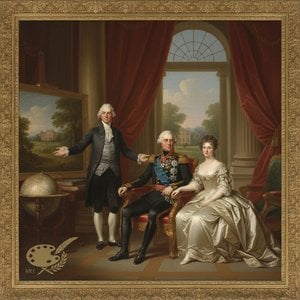
William Elford: A Banker's Brushstrokes – Bridging Finance and Artistic Vision
William Elford (1749 – 1837) stands as an intriguing figure in British art history, a man whose life intersected powerfully with the burgeoning Romantic movement while simultaneously maintaining a distinguished career in banking. More than just a wealthy gentleman dabbling in painting, Elford possessed a multifaceted intellect and unwavering dedication to both his profession and his artistic pursuits—a combination that resulted in a body of work characterized by sensitivity, meticulous observation, and an undeniable connection to the landscapes of Devonshire. Born into a prominent family rooted in Plymouth’s maritime heritage – the Elfords had been involved in trade for generations – William received an education that prioritized classical learning alongside practical skills. His father, Lancelot Elford, was a clergyman with considerable influence within the region, fostering in young William a respect for scholarship and intellectual curiosity. This upbringing undoubtedly shaped his worldview and instilled a desire to engage with the world beyond mere financial transactions. Grace Wills, his mother, brought into the family a lineage of artistic sensibilities, hinting at an inherent predisposition towards creative expression. Elford’s banking career began modestly but swiftly ascended as he partnered with Tingcombe & Clerk in Plymouth, establishing himself as a respected financier and securing positions within the town's administration. He served as Recorder of Plymouth from 1797 to 1833, demonstrating his commitment to civic duty and contributing significantly to the governance of Devonshire. Simultaneously, he pursued parliamentary representation, campaigning unsuccessfully for Rye in 1796 and Westbury later on—a testament to his ambition and engagement with political discourse. His involvement in the Irish Rebellion of 1798 further cemented his reputation as a patriot and underscore his willingness to serve his country actively. Notably, he commanded the South Devon Militia during this turbulent period, showcasing leadership qualities alongside artistic inclination. However, it was Elford’s artistic endeavors that truly captivated contemporaries and secured his place in art annals. He joined the Royal Academy exhibitions from 1774 until his death in 1837, consistently presenting landscapes imbued with Romantic ideals—particularly those depicting the dramatic beauty of Dartmoor and its environs. His paintings weren't merely decorative; they were meticulously crafted studies of light, color, and texture, reflecting a profound understanding of topographical accuracy combined with expressive artistic vision. Among his most celebrated works is ‘The White Lady of Avenel,’ completed in 1822—a haunting depiction of Dartmoor’s desolate moorland bathed in twilight hues. This painting exemplifies Elford's ability to capture the sublime, conveying both grandeur and melancholy with remarkable subtlety. Watercolor sketches found in the British Museum provide further evidence of his artistic versatility and meticulous attention to detail. Elford’s scientific pursuits complemented his artistic endeavors. Elected Fellow of the Royal Society in 1790 and subsequently Linnaean Society member in 1813, he investigated alternative yeast preparations—a pioneering effort that garnered considerable acclaim during his lifetime. This intellectual curiosity extended beyond botany; Elford was a sociable man who frequented Bath, engaging in lively discussions with literary luminaries and artists of the era. His legacy endures not only as a banker and politician but also as an artist whose canvases continue to resonate with viewers today—a testament to the enduring power of blending intellect and artistic passion.Questions et réponses
Combien d'œuvres de William Elford sont disponibles à la consultation ?
Vous pouvez parcourir 3 œuvres d'art œuvres de William Elford sur la page Toutes les œuvres.
Puis-je parcourir les œuvres de William Elford par palette de couleurs ?
Les œuvres de William Elford peuvent être parcourues par palette de couleurs sur la page Par palettes de l'artiste.
Où les œuvres de William Elford sont-elles regroupées par mots-clés ?
La page Par mots-clés de William Elford regroupe les œuvres de l'artiste par mots-clés.
À quelle période historique William Elford a-t-il exercé ?
William Elford a œuvré durant la période L'époque moderne. Cette période situe l'activité de l'artiste dans l'histoire.
Quelles œuvres de William Elford sont les plus consultées ?
Les statistiques relatives aux œuvres de William Elford sont disponibles sur la page Statistiques de l'artiste.
Dans quels mouvements William Elford a-t-il travaillé ?
La page Tous les mouvements regroupe les œuvres de William Elford par mouvement artistique.
D'où vient William Elford ?
William Elford est né(e) en Angleterre.