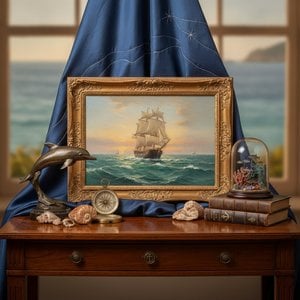
William Anderson (1757–1837): A Mariner's Vision of Britannia
William Anderson (1757 – 27 may 1837) stands as a pivotal figure in British maritime art, embodying the Romantic spirit and deeply rooted in the artistic traditions of the Dutch Golden Age. Born in Scotland, his formative years were marked by apprenticeship as a shipwright—a practical skill that undeniably informed his artistic sensibilities and provided him with an unparalleled understanding of naval craft and construction. This grounding in craftsmanship translated into meticulous detail and realism within his paintings, establishing him as one of the foremost practitioners of maritime art during his era.
Anderson’s artistic journey commenced formally at the Royal Academy in 1780, where he diligently honed his skills and continued to exhibit annually until 1811. Subsequent exhibitions occurred intermittently until 1834, showcasing a sustained commitment to capturing the grandeur and drama of seafaring life—a subject particularly resonant during the turbulent years of the French Revolutionary War and Napoleonic conflicts when Britain’s naval prowess was paramount. His artistic output extended beyond mere depictions of ships; he tackled ambitious historical narratives, skillfully blending meticulous observation with stylistic influences derived from celebrated Dutch masters like Rembrandt and Vermeer.
Anderson's oeuvre is characterized by a profound respect for accuracy and an unwavering dedication to conveying emotion through masterful technique. He meticulously studied naval architecture, painstakingly recreating the forms and textures of sailing vessels with astonishing precision—a testament to his apprenticeship and his innate artistic talent. This meticulous approach permeated his paintings, resulting in works that resonate with palpable atmosphere and dramatic lighting—elements central to the Romantic aesthetic. His canvases are imbued with a sense of grandeur and immediacy, transporting viewers back to pivotal moments in British maritime history.
- Notable Paintings: Anderson’s artistic output includes iconic masterpieces such as “Seascape With Shipping,” a breathtaking panorama of sailing vessels rendered in luminous watercolors that exemplifies the Romantic fascination with atmospheric perspective; “Limehouse Reach,” a detailed portrayal of London’s docks reflecting the burgeoning industrial landscape of Britain; and “View At The Mouth Of The Thames,” capturing the majesty of the estuary with loose brushstrokes and evocative color palettes. Particularly noteworthy is "The Battle Of Cape Finisterre," depicting Robert Faulknor's daring assault on Saint Louis during the Napoleonic Wars—a dramatic scene rendered with masterful composition and expressive use of light, mirroring the stylistic conventions of Rembrandt and Vermeer.
Anderson’s influence extended beyond his own artistic creations; he served as a mentor to John Ward, fostering a younger generation of artists who embraced similar stylistic approaches and pursued excellence in maritime art. His drawings were utilized for engravings in Rees’ Cyclopaedia, demonstrating his versatility as an artist and furthering the dissemination of knowledge through visual media—a significant contribution to the intellectual landscape of his time. He cultivated friendships with Julius Caesar Ibbetson, enriching Birmingham's artistic community during the early 19th century.
Anderson achieved particular renown for his monumental painting "The Battle Of Waterloo," commemorating Napoleon’s defeat—a testament to Anderson’s ability to convey emotion and grandeur through artistic technique. Similarly, “The Capture Of Fort Louis, Martinique,” depicts Robert Faulknor’s daring assault on Saint Louis during the Napoleonic Wars, showcasing a masterful grasp of composition and dramatic lighting. His legacy resides not only in his individual masterpieces but also in their contribution to shaping British maritime art history—a genre characterized by its unwavering devotion to realism, dramatic storytelling, and stylistic homage to Dutch artistic luminaries. William Anderson’s work continues to inspire admiration for its technical brilliance and emotional depth, cementing him as a cornerstone of Romantic painting and a symbol of Britain's naval heritage.