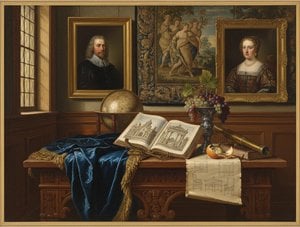
Willem Claesz. Heda: The Master of Subtle Light
Willem Claesz. Heda (born c. 1594, Haarlem?, Netherlands—died August 24, 1680, Haarlem) stands as a monumental figure in Dutch Baroque art, revered for his unparalleled mastery of still life painting and his profound understanding of the interplay between light and texture. Unlike many of his contemporaries who embraced grand narratives and dramatic gestures, Heda cultivated an aesthetic characterized by quiet contemplation and meticulous observation—a style that continues to captivate audiences today. His canvases are not merely depictions of objects; they are carefully constructed meditations on mortality and beauty, imbued with symbolic resonance that speaks volumes about the intellectual currents of the seventeenth century.
Early Life and Artistic Training
Information regarding Heda’s formative years remains scarce, shrouded in the mists of archival records. Born around 1594 in Haarlem—a thriving center for artistic production during the Golden Age—he descended from a family of engravers, suggesting an early exposure to visual arts and fostering a predisposition towards precise draughtsmanship. While biographical details are elusive, Heda’s training undoubtedly encompassed the humanist traditions prevalent at the time, emphasizing anatomical accuracy and intellectual engagement with classical ideals. His apprenticeship under Hendrick Jacobsz. Stoffel, a respected Haarlem painter known for his portraits and landscapes, solidified his foundational skills and instilled in him a commitment to artistic excellence—a dedication that would define his entire career.
The Emergence of Heda’s Distinctive Style
Heda's breakthrough came around 1621 with the creation of *Still Life with Oyster Shells*, a seminal work that instantly established his signature aesthetic: restrained compositions featuring delicate arrangements of glass vessels, metal objects, and subtle textural nuances. Unlike the opulent displays favored by artists like Rembrandt or Rubens, Heda eschewed flamboyant ornamentation in favor of an austere elegance—a deliberate choice reflecting the burgeoning influence of Cartesian philosophy, which championed reason and clarity over emotion and sensory experience. His palette consisted primarily of silvery grays, golden yellows, and browns, painstakingly blended to achieve remarkably accurate tone values—a technique that mirrored the scientific investigations into optics undertaken during Heda’s era.
Symbolism and Philosophical Depth
Heda's paintings transcend mere visual representation; they are laden with symbolic significance rooted in humanist thought and Christian piety. Recurring motifs—such as oysters, lemons, pewter vessels, and feathers—were deliberately chosen to convey concepts of decay, fragility, and the ephemeral nature of earthly existence—themes central to the *vanitas* genre, which flourished during Heda’s lifetime. These objects served as reminders of mortality, prompting viewers to contemplate the futility of worldly pursuits in comparison to spiritual salvation. Heda's meticulous attention to detail extended beyond mere technical proficiency; it reflected a profound engagement with philosophical ideas about time, death, and divine providence—ideas that resonated deeply within the intellectual landscape of Amsterdam and Haarlem.
Major Achievements and Legacy
Throughout his prolific artistic output (spanning from 1621 until his death in 1680), Heda produced an astonishing array of still lifes—over 350 extant paintings—that cemented his reputation as one of the foremost masters of Baroque art. His works graced the homes of aristocratic patrons and royal collections alike, demonstrating their enduring appeal to discerning tastes. Notably, he collaborated extensively with Johannes Vermeer, creating several collaborative pieces that further refined Heda’s stylistic innovations. Beyond his technical virtuosity, Heda's legacy resides in his ability to distill complex philosophical concepts into visually arresting compositions—a feat achieved through unwavering dedication to observation and a profound understanding of the transformative power of light. His paintings continue to inspire admiration for their understated beauty and intellectual depth—testaments to the enduring influence of a singular artistic vision.
Influence and Artistic Context
Heda’s stylistic approach profoundly impacted subsequent generations of Dutch painters, establishing him as a pivotal figure in shaping Baroque aesthetics. He championed a method of painting that prioritized tonal gradation and textural subtlety—a technique that contrasted sharply with the prevailing tendencies toward dramatic chiaroscuro employed by Rembrandt and Rubens. Heda's influence extended beyond mere stylistic imitation; he instilled in his pupils a commitment to intellectual rigor and a sensitivity to humanist ideals—values that underpinned the artistic achievements of artists such as Pieter Claesz., Frans Hals, and Johann Vermeer. His work stands as an exemplar of Baroque art’s capacity for conveying profound philosophical ideas through exquisitely crafted visual imagery—a testament to Heda's enduring contribution to European art history.