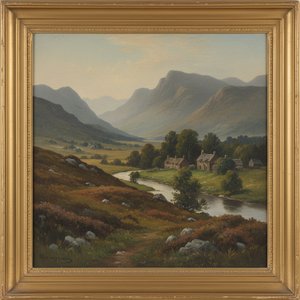
Wilhelm Velten (1847 - 1929): A Pioneer of Romantic Landscape Painting
Wilhelm Velten was born in St. Petersburg, Russia, in 1847, a formative experience that instilled within him an enduring fascination with the stark beauty of winter landscapes – a motif he would revisit throughout his prolific artistic career. Though he spent much of his childhood immersed in Russian culture and traditions, Velten’s ambition led him to relocate to Germany at a young age, establishing himself firmly in Munich where he cultivated relationships with fellow artists and embraced the burgeoning Secession movement. He passed away peacefully in Munich in 1929, leaving behind an impressive legacy as one of Germany's foremost landscape painters of his era.
Early Training & Influences
Velten’s artistic education began at the Academy of Fine Arts in St. Petersburg under Wilhelm von Diez, a teacher who championed realism and emphasized meticulous observation of nature. This foundational training profoundly shaped Velten's approach to painting, prioritizing accuracy and capturing subtle nuances of light and atmosphere. Notably, he was influenced by Romantic painters like Caspar David Friedrich, whose monumental landscapes conveyed profound spiritual contemplation – an aesthetic sensibility that would permeate Velten’s own compositions. Friedrich’s canvases—characterized by austere grandeur and symbolic resonance—served as a guiding inspiration for Velten, encouraging him to infuse his paintings with emotional depth and intellectual rigor.
Munich & The Secession
Moving to Munich in the 1870s coincided with Velten's involvement in the Munich Secesja (Vienna Secesja), a group of avant-garde artists who rejected academic conventions and sought new expressive possibilities. This association fostered experimentation with color palettes and compositional techniques, propelling Velten’s artistic development toward bolder visual statements. The Secession’s rejection of traditional artistic hierarchies—particularly its insistence on prioritizing emotional impact over formal correctness—resonated deeply with Velten's sensibilities, prompting him to challenge established norms and forge his own distinctive artistic path. He collaborated closely with fellow Secession artists, exchanging ideas and pushing boundaries in pursuit of innovative aesthetic visions.
Velten's Artistic Style & Technique
Wilhelm Velten distinguished himself through his masterful command of oil paint—primarily on panel—employing a technique characterized by layered brushstrokes that achieved remarkable textural depth and luminosity. He meticulously rendered winter landscapes with an unwavering commitment to realism, capturing the crystalline brilliance of snowdrifts and the muted hues of frosted trees. His paintings weren’t merely depictions of scenery; they were imbued with emotion – conveying a sense of solitude, contemplation, and reverence for the sublime grandeur of the natural world. Velten's meticulous attention to detail—particularly in portraying horsemen and military uniforms—demonstrated his fascination with historical subjects and his ability to infuse them with psychological insight. He favored a restrained palette dominated by blues, whites, and grays—colors that mirrored the icy tones of his chosen subjects—and utilized expressive brushstrokes to convey texture and movement, creating canvases that pulsated with atmospheric energy.
Notable Works & Recognition
Among Velten’s most celebrated paintings are “A Horse and Carriage by a River,” which exemplifies his signature style—a breathtaking panorama of snow-covered terrain punctuated by the graceful presence of equine figures—and “Kaiser-wilhelm-museum,” showcasing his ability to capture the grandeur of architectural spaces alongside evocative landscapes. His works gained international acclaim, securing prominent positions in museums across Europe and cementing his reputation as a visionary artist who elevated landscape painting to new heights of artistic sophistication. Velten’s legacy continues to inspire artists today, reminding us of the enduring power of observation and the transformative potential of art to convey profound emotional resonance. He was recognized for his contribution to German Romanticism and admired for his unwavering dedication to capturing the essence of winter landscapes with unparalleled artistry.