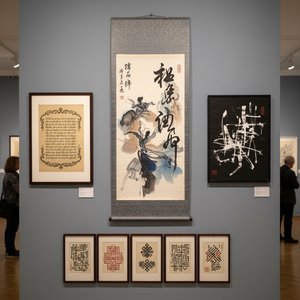
Wang Mingming : Conjuguer Tradition et Modernité par la Poésie de l'Encre
Wang Mingming, né à Pékin en 1952, s'impose comme une figure singulière du paysage de l'art chinois contemporain — un témoignage de la puissance durable d'une tradition réimaginée à travers une sensibilité résolument moderne. Son voyage artistique a débuté par une fascination instinctive pour les thèmes de la peinture chinoise ancienne, évoluant rapidement vers un engagement profond avec l'esprit et l'essence de la calligraphie et de la poésie classiques. Cette double influence imprègne son œuvre, donnant naissance à des créations qui résonnent d'une beauté intemporelle et d'une émotion palpable.- Jeunesse et premiers pas artistiques : Issu de modestes origines à Penglai, dans la province du Shandong, les inclinations artistiques de Wang Mingming sont apparues très tôt — une passion d'enfance nourrie par une approche autodidacte et guidée par des maîtres influents tels que Jiang Zhaohe et Lu Chen. Ces expériences formatrices ont instauré en lui un dévouement inébranlable à la maîtrise des techniques traditionnelles de la peinture à l'encre, façonnant sa vision artistique pour les décennies à venir.
- Formation académique et mentors illustres : La quête d'excellence de Wang Mingming s'est poursuivie par son admission à la Central Academy of Art de Pékin, où il a perfectionné ses compétences sous l'égide de luminaires tels que Wu Zuoren et Lu Chen — des artistes qui prônaient un mélange harmonieux de rigueur intellectuelle et d'intuition artistique. Ces mentors lui ont transmis non seulement une maîtrise technique, mais aussi une profonde appréciation des fondements philosophiques de l'art chinois.
- Exploration de la poésie ancienne et vision du paysage : Inspiré par le riche patrimoine culturel de la Chine, Wang Mingming s'est lancé dans une exploration délibérée de la poésie chinoise ancienne — une pratique qui informe profondément son processus artistique et imprègne ses peintures d'une résonance lyrique. Il capture avec brio la grandeur des paysages montagneux, reflétant l'esprit contemplatif de la philosophie taoïste et transmettant un sentiment de beauté sublime.
- Technique et style : Le style distinctif de Wang Mingming se caractérise par des coups de pinceau expansifs — une rupture délibérée avec les conventions occidentales — qui évoquent l'espace et la liberté imaginative des peintures de lettrés. Il emploie un contrôle méticuleux de la dilution et de la superposition de l'encre, atteignant une profondeur texturale remarquable et transmettant de subtiles nuances d'émotion. Ses rouleaux monumentaux, dépassant souvent dix mètres de long, représentent une démonstration magistrale d'échelle et de perspective.
- Reconnaissance et héritage : Les accomplissements artistiques de Wang Mingming ont reçu un écho international — incluant des distinctions de l'International Association of Artists of the United States — consolidant sa position parmi les plus grands peintres à l'encre contemporains de Chine. Son travail continue d'inspirer les artistes du monde entier, incarnant un engagement intemporel pour la préservation et la réinvention de l'héritage de l'art chinois pour les générations futures.
Expositions Notables et Collections
Les explorations artistiques de Wang Mingming ont traversé les continents — de Singapour et Hong Kong à l'Australie, la Corée, le Japon, Taïwan et la France — où ses peintures ont captivé les publics par leur beauté évocatrice et leur profondeur intellectuelle. Ses œuvres sont conservées dans des collections prestigieuses, notamment le Musée National d'Art de Pékin et le Musée d'Art de Singapour, reflétant l'appréciation durable pour sa vision unique.Influences et Philosophie Artistique
La philosophie artistique de Wang Mingming est ancrée dans une profonde révérence pour la tradition chinoise — particulièrement la cosmologie taoïste et la calligraphie — qui guide son approche de la composition et de la palette chromatique. Il puise son inspiration dans les principes architecturaux des jardins et temples anciens, cherchant à créer des espaces qui favorisent la contemplation et évoquent un sentiment d'harmonie avec la nature. Son travail reflète une croyance en le pouvoir transformateur de l'art — la conviction qu'il peut éclairer la condition humaine et transcender les frontières culturelles.Pensées Finales
La contribution de Wang Mingming à l'art chinois contemporain est indéniable — il représente un phare d'intégrité artistique et d'innovation, démontrant comment la tradition peut être revitalisée sans sacrifier l'originalité. Ses peintures poétiques à l'encre servent de puissant rappel que la beauté ne réside pas seulement dans la splendeur visuelle, mais aussi dans l'engagement intellectuel — un héritage destiné à inspirer les artistes pendant encore de nombreuses années.Questions et réponses
Où et en quelle année Wang Mingming est-il né ?
Wang Mingming est né à Penglai en 1952.
Comment la carrière de Wang Mingming est-elle divisée en périodes ?
La Chronologie de Wang Mingming est une frise chronologique interactive qui présente les œuvres de l'artiste par ordre chronologique, regroupées en chapitres correspondant aux différentes périodes de sa carrière.
Puis-je visiter un musée virtuel des œuvres de Wang Mingming ?
Une visite virtuelle est possible : la page Musée 3D de Wang Mingming présente les œuvres de l'artiste dans une galerie en trois dimensions.
Quelles couleurs Wang Mingming a-t-il le plus souvent utilisées ?
L'usage de la couleur par Wang Mingming à travers les œuvres répertoriées sur ce site web peut être étudié sur la page Génome de la palette de l'artiste.
Dans quels mouvements Wang Mingming a-t-il travaillé ?
La page Tous les mouvements regroupe les œuvres de Wang Mingming par mouvement artistique.
Existe-t-il une liste complète des œuvres de Wang Mingming ?
Chaque œuvre de Wang Mingming sur ce site web peut être consultée depuis la page Toutes les œuvres de l'artiste.
Quelles émotions les œuvres de Wang Mingming expriment-elles ?
La L'ambiance par émotion de Wang Mingming est une page qui organise les œuvres de l'artiste par ambiance.
Existe-t-il une chronologie des œuvres de Wang Mingming ?
La page Chronologie des œuvres de l'artiste présente les œuvres de Wang Mingming classées par date, année par année.