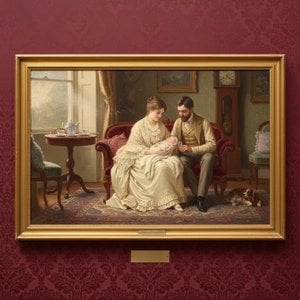
L'Élégance d'un Visionnaire Victorien
Né dans le cadre pittoresque de Dorking, dans le Surrey, en 1854, Walter Dendy Sadler s'est imposé comme une voix emblématique de l'âge d'or de la peinture de genre britannique. Sa vie et son œuvre constituent une fenêtre lumineuse sur le cœur de l'ère victorienne, capturant non seulement les visages de ses contemporains, mais l'âme même de leur tissu social. En naviguant dans le paysage artistique florissant de Londres, Sadler s'est trouvé entouré des influences profondes de figures illustres telles que Frederic Leighton et William Holman Hunt. De ces maîtres, il a hérité une profonde appréciation pour la beauté idéalisée et la quête de vertu morale, tout en infusant ces inspirations classiques d'un charme observationnel unique qui célébrait les nuances de l'existence quotidienne.
Le développement artistique de Sadler fut marqué par une capacité extraordinaire à marier un détail méticuleux à un profond sens de l'atmosphère. Il possédait un don rare pour manipuler la lumière, l'utilisant pour insuffler la vie tant aux intérieurs domestiques qu'aux paysages baignés de soleil. Sa touche, caractérisée par sa précision, lui permettait de documenter les textures subtiles de la soie, les motifs délicats de la broderie et la lueur douce des bougies. Cette maîtrise technique n'était jamais une fin en soi ; elle servait plutôt son dessein plus grand : explorer les coutumes sociales et les aspirations silencieuses d'une société prise entre la tradition et l'aube d'une ère nouvelle.
Récits de Domesticité et de Désir
La véritable magie de l'œuvre de Sadler réside dans sa capacité à transformer des moments ordinaires en récits extraordinaires. Il devint particulièrement renommé pour ses représentations de femmes, les dépeignant dans le cadre serein de la vie domestique. Dans ces scènes, on découvre une exploration profonde de la féminité victorienne — montrant des femmes absorbées par la contemplation, l'ouvrage d'aiguille ou la réception gracieuse d'invités. Il ne s'agissait pas de simples portraits de loisirs, mais d'études soigneusement orchestrées sur la grâce, le décorum et la beauté tranquille que l'on trouve au foyer.
Au-delà de la sphère domestique, le travail de Sadler s'aventurait souvent vers le romantique et le grandiose, utilisant la composition pour susciter de profondes réponses émotionnelles :
- La Grandeur de la Société : Dans des œuvres telles que « London to York Times Up Gentlemen », Sadler démontre une maîtrise magistrale de la perspective. Ce panorama saisissant d'un rassemblement social luxueux utilise un décor opulent et une illumination dramatique pour inviter le spectateur dans la splendeur rituelle de la haute société.
- Le Romantisme de la Campagne : À l'inverse, des peintures comme « The Suitor » révèlent son talent pour la narration pastorale. Ici, l'artiste capture un cadre rural idyllique débordant de promesses romantiques, où le paysage lui-même semble participer aux émotions indicibles des personnages.
- La Connexion Humaine : À travers des pièces telles que « The Village Postman », Sadler met en lumière la beauté poignante des interactions humaines simples, documentant les moments tendres de cour et de communauté qui définissent l'expérience humaine.
Un Héritage Durable dans l'Art Britannique
Alors que l'ère victorienne transitionnait vers la période édouardienne, l'œuvre de Sadler est demeurée un pilier inébranlable de la peinture de genre. Sa signification réside dans son rôle d'historien visuel ; il ne se contentait pas de peindre des scènes, il archivait les valeurs, l'esthétique et les hiérarchies sociales de son temps. À travers ses palettes de couleurs évocatrices et ses compositions rythmiques, il a créé un monde qui semblait à la fois intimement familier et d'une beauté aspirante pour son public.
Bien qu'il se soit éteint en 1923, l'héritage de Walter Dendy Sadler continue de résonner auprès des amateurs d'art du monde entier. Sa capacité à trouver l'extraordinaire dans l'ordinaire garantit que ses peintures restent bien plus que des artefacts historiques. Elles sont des fenêtres vivantes et vibrantes sur un monde disparu, offrant un sentiment de nostalgie et une profonde appréciation pour l'art de la connexion humaine et la beauté éternelle du quotidien.
Questions et réponses
Puis-je explorer les œuvres de Walter Dendy Sadler par spectre de couleurs ?
Les œuvres de Walter Dendy Sadler peuvent être explorées par couleur sur la page Index spectral de l'artiste.
Où puis-je voir la palette de couleurs des œuvres de Walter Dendy Sadler ?
La Génome de la palette de Walter Dendy Sadler est une page qui présente le profil chromatique de l'ensemble de l'œuvre de l'artiste.
Puis-je parcourir les œuvres de Walter Dendy Sadler par palette de couleurs ?
La page Par palettes regroupe les œuvres de Walter Dendy Sadler par leurs palettes de couleurs.