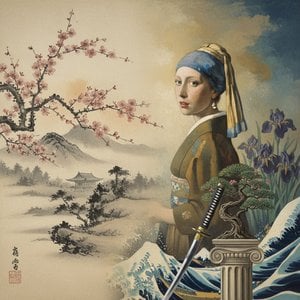
Tosa Mitsuyoshi : A Master of the Muromachi and Momoyama Eras
Tosa Mitsuyoshi, born in Kyoto in 1539 and passing away in 1613, stands as a pivotal figure in Japanese painting history. His life coincided with a period of immense artistic transformation, bridging the traditions of the Muromachi era with the burgeoning innovations of the Momoyama period. Initially, he succeeded the esteemed Tosa school, inheriting its legacy as the head of the imperial painting bureau (edokoroazukari), a position that afforded him unparalleled access to the court and shaped his artistic trajectory. However, circumstances led him to relocate his studio to Sakai, a bustling port city near Osaka, where he found patronage amongst wealthy merchants – a shift reflecting the changing economic landscape of Japan. This relocation marked not just a geographical change but also a strategic adaptation to evolving artistic demands. Mitsuyoshi’s artistic contributions are primarily defined by his exquisite illustrated handscrolls (emaki), particularly those depicting scenes from *The Tale of Genji* (Genji Monogatari). These works, such as the celebrated “Oak Tree” (Kashiwagi-no Mori), exemplify a remarkable synthesis of traditional Japanese painting techniques – notably the delicate brushwork and vibrant color palette characteristic of the Tosa school – with influences drawn from Chinese art. The use of gold leaf, particularly in pieces like "Butterflies," elevates these scrolls to breathtaking levels of beauty and detail, demonstrating a mastery of materials and a profound understanding of visual harmony. His work isn’t simply reproduction; it's an interpretation imbued with his own artistic sensibility.The Tosa School and its Legacy
The Tosa school itself represents a cornerstone of Japanese art history. Founded by Tosa Yukihiro in the early 15th century, it established a unique tradition centered around *yamato-e*, a style emphasizing native Japanese aesthetics and techniques distinct from those heavily influenced by Chinese models. The hereditary position of head of the imperial painting bureau provided the school with considerable prestige and influence within the courtly circles. Members of the Tosa family meticulously maintained this role, shaping artistic trends and setting standards for generations to come. Mitsuyoshi’s work directly continued this lineage, building upon the foundations laid by his predecessors while also introducing subtle yet significant innovations. The school's dedication to depicting scenes from classic literature, particularly *The Tale of Genji*, solidified its place as a dominant force in courtly art.Key Artistic Features and Techniques
Mitsuyoshi’s artistic style is immediately recognizable through several key features. His brushwork is consistently characterized by an exceptional level of delicacy and control, creating intricate details and conveying subtle nuances of expression. The color palette employed is remarkably vibrant, utilizing a rich array of pigments to achieve luminous effects and evoke specific moods. Furthermore, Mitsuyoshi demonstrated a pioneering use of gold leaf – not merely as ornamentation but as an integral element contributing to the overall composition and visual impact. This masterful manipulation of materials—ink, pigment, and gold—is particularly evident in works like “The Oak Tree,” where the shimmering gold leaf enhances the sense of depth and grandeur.Notable Works and Historical Context
Among Mitsuyoshi’s most celebrated creations is "The Oak Tree," a stunning example of his skill and artistry, often considered a highlight of the Momoyama period (1573–1615). His depiction of the scene from *The Tale of Genji* showcases his ability to capture both the narrative drama and the subtle emotional complexities of the story. “Butterflies,” another significant work, exemplifies his mastery of composition and color harmony. The "Drinking Festival of the Eight Immortals of the Wine Cup" (Kōmatsu no taikai) is a testament to his versatility, blending traditional motifs with a refined aesthetic sensibility. It’s important to note that while these works are often attributed solely to Mitsuyoshi, they frequently represent collaborative efforts within the Tosa school, reflecting the shared artistic practices of its members.Influence and Enduring Legacy
Tosa Mitsuyoshi's contributions to Japanese art are undeniable. His work is now housed in prestigious collections such as the Freer Gallery of Art, a testament to his enduring influence. The Tosa Mitsuyoshi collection on WahooArt.com serves as a valuable resource for scholars and enthusiasts alike, offering a comprehensive overview of his artistic output. Further exploration into the broader context of Japanese art – including the Nanga (Southern School) movement and the Kanō school style – provides deeper insights into the influences shaping Mitsuyoshi’s work and its place within the wider artistic landscape. Recommended readings include “Painting by ‘Tosa Mitsuyoshi’ | Tosa Mitsuyoshi: “The Oak Tree”,” and studies of Tosa Mitsuoki, a notable successor to the Tosa school. His legacy continues to inspire artists and art lovers today, demonstrating the power of tradition, innovation, and artistic vision.Questions et réponses
Existe-t-il un aperçu de tous les sujets peints par Tosa Mitsuyoshi ?
Les œuvres de Tosa Mitsuyoshi peuvent être explorées par sujet sur la page Atlas thématique de l'artiste.
Puis-je étudier l'utilisation de la couleur par Tosa Mitsuyoshi à travers l'ensemble de ses œuvres ?
L'usage de la couleur par Tosa Mitsuyoshi à travers les œuvres répertoriées sur ce site web peut être étudié sur la page Génome de la palette de l'artiste.
Comment puis-je trouver des œuvres de Tosa Mitsuyoshi dans une palette spécifique ?
La page Par palettes regroupe les œuvres de Tosa Mitsuyoshi par leurs palettes de couleurs.