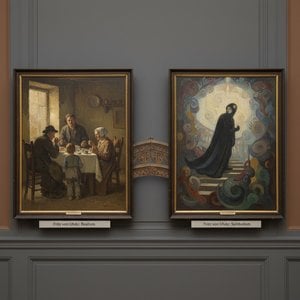
Theodor Leopold Weller: A Master of Everyday Life
Theodor Leopold Weller (May 29, 1802 – December 10, 1880), born in Mannheim, Germany, stands as a pivotal figure within the Munich School of painting—a movement dedicated to portraying scenes from ordinary life with remarkable precision and psychological insight. Initially envisioned for a legal profession by his father, Weller’s passion for art swiftly took precedence, embarking on formal studies at the Academy of Fine Arts in Munich under Johann Peter von Langer, where he encountered the influential Peter von Cornelius, brought to Munich by Ludwig II to oversee the Glyptothek. Unlike many of his contemporaries who pursued grand historical narratives or mythological subjects, Weller deliberately gravitated towards depictions of daily existence and the natural world—a decision that profoundly shaped his artistic trajectory. This singular focus distinguished him from his peers and cemented his place as a champion of realism within the Romantic movement.
Early Influences & Training
Langer’s guidance instilled in Weller a foundational understanding of academic painting principles, emphasizing anatomical accuracy and compositional balance – techniques considered essential for conveying emotion effectively. Simultaneously, Cornelius's presence exposed him to the burgeoning Romantic spirit prevalent in Munich, fostering an appreciation for dramatic landscapes and expressive brushwork. This confluence of influences shaped Weller’s artistic sensibilities from his formative years, preparing him for a career dedicated to capturing the complexities of human experience.
The Pursuit of Detail: Mastering Observation
Weller honed his technique under Peter von Hess, arguably the most celebrated watercolorist of his time—a master of meticulous observation and rendering. Hess championed a style characterized by luminous color palettes and subtle tonal gradations, encouraging Weller to prioritize accuracy and nuance in his depictions. This unwavering commitment to detail became synonymous with Weller’s oeuvre, elevating genre painting to new heights of artistic accomplishment and establishing him as a leading voice within the Munich School. His paintings are renowned for their remarkable realism—a testament to Hess's influence and Weller's exceptional skill.
Roman Exploration & Artistic Growth
In 1825, Weller embarked on an unforgettable journey to Rome alongside Ernst Fries—a formative experience that irrevocably broadened his artistic horizons. This expedition instilled in him a deep admiration for classical ideals—particularly the serene beauty of idealized landscapes—and fueled his desire to integrate elements of Greco-Roman art into his own compositions. He diligently documented his travels through Italy, capturing the essence of Italian culture and incorporating vibrant colors and atmospheric perspective into his watercolors—a stylistic hallmark that would define his artistic output for decades to come.
Career Highlights & Artistic Output: Director of the Kunstverein
Returning to Mannheim in 1833, Weller established himself as a respected artist and educator, accepting the role of Director of the Mannheim Kunstverein (Art Association) from 1839 to 1848. During this tenure—spanning twenty-three years—he served on the board with unwavering dedication—curating the Verein’s collection with meticulous care and fostering an environment conducive to artistic innovation. He championed German Romanticism, advocating for a style that prioritized emotional resonance alongside technical virtuosity. Weller's prolific output included captivating genre scenes—such as “Studies on a Bagpiper” (1851) and “Standing Woman in the Costume of Cervara,” showcasing his mastery of watercolor and capturing nuanced emotional states. These paintings remain treasured examples of Romantic realism, embodying Weller’s profound understanding of human psychology and his unparalleled ability to translate emotion onto canvas.
Historical Significance & Legacy
Theodor Leopold Weller died peacefully in Mannheim on December 10, 1880, succumbing to a stroke—a tragic end for an artist whose life’s work embodied the spirit of observation, empathy, and artistic excellence. His enduring influence can be seen in subsequent generations of German painters who embraced his commitment to portraying the human condition with sensitivity and unwavering detail. Weller's legacy continues to inspire artists today who strive for authenticity and emotional resonance—solidifying his place as one of the most important figures within the Munich School and ensuring that his masterful depictions of everyday life endure as timeless expressions of Romantic artistic vision.