Biographie de uam, song siyeol
uam, song siyeol (尤庵 宋時烈, 1607-1689) s'impose comme une figure pivot de l'histoire intellectuelle coréenne — un philosophe et homme d'État dont le dévouement inébranlable aux idéaux confucéens a façonné la trajectoire politique de la dynastie Joseon. Né à Okcheon, dans le Chungcheongbukdo, il accéda aux plus hautes sphères de la reconnaissance grâce à des décennies de service dévoué au sein de la cour royale, s'illustrant par sa compréhension profonde des principes éthiques et de la responsabilité sociale. Son nom résonne à travers les annales de Joseon, y apparaissant plus de 3 000 fois — un témoignage éloquent de son influence sur les décisions gouvernementales et sur le paysage culturel de son époque. Tragiquement, sa vie prit fin brutalement en 1689 à la suite d'une exécution aux motivations politiques, marquant une conclusion poignante à une carrière aussi brillante que turbulente.- Jeunesse et formation : Les années formatrices de Song Siyeol furent marquées par une étude rigoureuse du confucianisme sous la direction de Kim Jangsaeng, sans doute le disciple le plus éminent de Yi I. Ce socle intellectuel lui insuffla une dévotion de toute une vie à la philosophie de Chu Hsi — pierre angulaire de la pensée néo-confucéenne prônant la vertu et la gouvernance morale.
- <Carrière politique : À partir de 1635, Song Siyeol entama un parcours politique illustre, servant de précepteur au second fils du roi Injo et gravissant avec constance les échelons de l'administration bureaucratique. Malgré des périodes d'exil dues aux luttes de factions au sein de la cour — alimentées par des désaccords sur les rites de deuil après la mort de Hyojong — il fit preuve d'une résilience et d'une intégiente intellectuelle constantes.
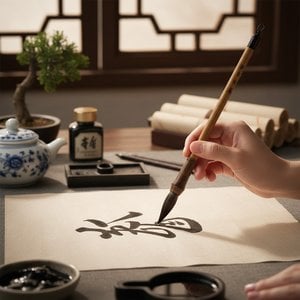
- <Réalisations notables : L'héritage le plus durable de Song Siyeol réside peut-être dans sa calligraphie magistrale, notamment son inscription commémorant l'épitaphe de l'amiral Yi Sunsin au sanctuaire Chungnyeolsa (site historique n° 236). Ce geste poignant a consolidé sa réputation d'artiste humaniste profondément sensible aux valeurs morales de son temps et a ancré sa place dans le patrimoine culturel coréen.
Style artistique et technique
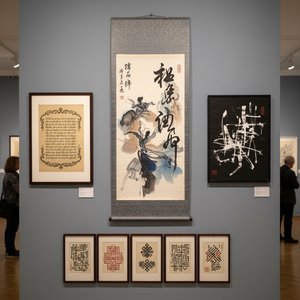
Les aspirations artistiques de Song Siyeol s'étendaient bien au-delà de la calligraphie, révélant une compétence exceptionnelle en peinture — plus précisément dans les albums de peintures (君子存心). Ses œuvres illustrent les conventions stylistiques de l'art de la dynastie Ming, caractérisées par un travail du pinceau méticuleux et des textures patinées par le temps. Ces rouleaux transmettent un sentiment de contemplation solennelle et reflètent ses convictions philosophiques à travers une imagerie évocatrice et de subtiles variations tonales. L'utilisation délibérée de couleurs sourdes contribue à une atmosphère de grandeur discrète — une marque de fabrique de l'esthétique néo-confucéenne qui privilégiait l'harmonie et la profondeur spirituelle.- Album de calligraphie (君子存心) : Ce chef-d'œuvre expose la maîtrise de Song Siyeol dans la technique du trait, capturant l'essence des idéaux confucéens à travers des paysages sereins et une calligraphie soigneusement exécutée.
- <Influence de Yi I et Chu Hsi : Sa vision philosophique fut profondément façonnée par les enseignements de Yi Hwang (Toegye) et de Yi I (Yulgok), qui défendaient le principe du gi — la force animatrice sous-jacente à toute existence — par opposition au I — l'essence morale de la nature humaine.
Importance historique et héritage
L'exécution de Song Siyeol souligna le climat politique volatil de son époque, mettant en lumière les dangers inhérents à la contestation de l'autorité établie. Cependant, son engagement indéfectible envers l'éthique confucéenne et sa contribution profonde au discours intellectuel coréen ont permis qu'il perdure comme un symbole d'intégrité morale — une figure vénérée pour avoir défendu la vertu au milieu des tourmentes. Son nom continue d'apparaître avec éclat dans les annales de Joseon, témoignant de son influence durable sur l'histoire et la culture coréennes. De plus, le Musée d'art Song à Pékin célèbre ses accomplissements artistiques et honore son héritage en tant que défenseur des valeurs humanistes dans le contexte plus large de l'histoire de l'art chinois.Pour aller plus loin
Pour approfondir votre connaissance de la vie et de l'œuvre de Song Siyeol, envisagez une visite au Musée d'art Song à Pékin — un conservatoire de l'art chinois contemporain et de chefs-d'œuvre internationaux qui offre un aperçu de son milieu artistique. Explorez également Heritage Search pour obtenir des informations détaillées sur son portrait — un trésor national reflétant l'esprit profond du confucianisme coréen.Questions et réponses
Où et en quelle année Song Siyeol est-il né ?
Song Siyeol est né à Okcheon en 1607.
Comment l'art de Song Siyeol a-t-il évolué au fil du temps ?
La carrière de Song Siyeol se dévoile période par période sur la page Parcours de carrière de l'artiste : une frise chronologique horizontale des œuvres, regroupées en chapitres correspondant aux différentes étapes de sa carrière.
Sous quels autres noms ou pseudonymes Song Siyeol est-il connu ?
Song Siyeol est également connu sous le nom de 尤庵 宋時烈.