Early Life and Artistic Beginnings
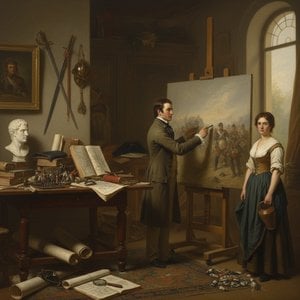
Simon Opzoomer, born in Rotterdam, Netherlands, in 1819, emerged from a period of significant artistic transition. While details surrounding his early life remain somewhat elusive, it is known that he dedicated himself to the study of painting at a young age. The Dutch Golden Age’s legacy still resonated strongly within the art world of the 19th century, but new Romantic and historical currents were beginning to shape artistic expression. Opzoomer's initial training likely involved mastering traditional techniques—the meticulous detail and realism prized by earlier generations—but he soon gravitated towards a more narrative and emotionally charged style. His early works suggest an aptitude for portraiture, hinting at a keen observational skill and a desire to capture the inner lives of his subjects. The Netherlands in the 19th century was undergoing rapid social and political change, and this context would profoundly influence Opzoomer’s choice of subject matter as he matured.
A Focus on Historical Narrative
Opzoomer quickly distinguished himself through a specialization in historical painting—a genre that allowed him to engage with the dramatic events and compelling figures of Dutch history. He wasn't merely recreating scenes from the past; his paintings were imbued with a sense of moral weight and emotional intensity. His work often centered on moments of high drama, exploring themes of patriotism, sacrifice, and religious conviction. “The Last Prayer of Johan van Oldenbarnevelt”, for example, exemplifies this approach—a powerful depiction of the statesman facing his execution with unwavering faith. This painting is not simply a historical record; it’s an exploration of courage in the face of adversity, rendered with meticulous attention to detail and a palpable sense of solemnity. Opzoomer's ability to convey such emotional depth through composition, lighting, and character portrayal quickly garnered him recognition within artistic circles.
Technique and Influences
Opzoomer’s technique was rooted in the traditions of Dutch Realism, but he incorporated elements of Romanticism to heighten the dramatic impact of his scenes. His brushwork is characterized by precision and clarity, allowing for a detailed rendering of textures, fabrics, and facial expressions. He skillfully employed chiaroscuro—the contrast between light and shadow—to create a sense of depth and emphasize key figures within his compositions. While specific artistic influences are difficult to pinpoint definitively, it’s likely that he drew inspiration from contemporary history painters in both the Netherlands and France. The works of artists who focused on similar themes of national identity and moral struggle would have undoubtedly informed his own approach. His paintings often feature a rich color palette and a carefully constructed sense of space, drawing the viewer into the heart of the historical moment.
Recognition and Legacy
Throughout his career, Opzoomer’s works were exhibited in various galleries and salons, attracting attention from collectors and critics alike. While he may not have achieved the widespread fame of some of his contemporaries, his paintings consistently commanded respectable prices—ranging from US$1,000 to US$10,000 at auction, with “Magdalena Moons Begs Her Fiancé Francisco Valdez to Postpone the Storming of Leiden Another Night, 1574” achieving a high price of US$10,000 in 2019. This demonstrates a sustained appreciation for his skill and artistic vision. Opzoomer’s legacy lies in his ability to breathe life into historical narratives, transforming them into emotionally resonant works that continue to captivate audiences today. His paintings serve as valuable reminders of the Dutch past—not merely as records of events, but as explorations of the human spirit and the enduring power of conviction. He died in 1878 leaving behind a collection of poignant portraits and historical scenes.