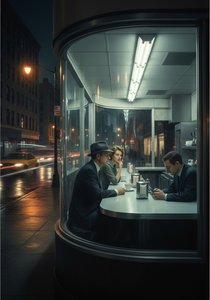
Robert William Cottingham: The Quiet Observer of Urban Decay
Robert William Cottingham (1935 – Present) occupies a unique position within American Realism, prioritizing subtle beauty and melancholic truth over grand narratives or theatrical displays. Born in Brooklyn, New York, his artistic path began with studies in advertising and graphic design at Pratt Institute, equipping him with foundational visual skills before dedicating himself to the enduring craft of painting—a conscious departure from stylistic trends that would have diminished the profound impact of his oeuvre. Cottingham deliberately resists categorization as a “photorealist,” asserting instead that he operates within the rich tradition of American vernacular scenes – a deliberate stance reflecting his conviction that art possesses the capacity to illuminate everyday experience and unveil hidden depths within familiar surroundings.
Cottingham’s distinctive style is characterized by meticulous detail and an almost obsessive preoccupation with architectural fragments and commercial signage—elements frequently disregarded by other artists. His canvases breathe life into weathered brick walls, peeling paint, faded billboards, and illuminated storefront windows with astonishing accuracy, transforming these commonplace objects into subjects of contemplative beauty. This stylistic choice wasn’t born in isolation; Cottingham’s formative influences included William Glackens and Henry William Pickersgill—painters who championed Ashcan Realism and bravely confronted the gritty realities of early 20th-century American life. These artists instilled within him a fundamental belief that art could serve as a conduit for social commentary, exposing vulnerabilities and celebrating resilience amidst urban landscapes.
His breakthrough arrived in 1971 with his debut solo exhibition at Ok Harris Gallery in New York City—a pivotal moment marking the commencement of a prolific career punctuated by numerous exhibitions and commissions across North America and Europe. Cottingham’s work swiftly gained considerable acclaim throughout the decades, culminating in an election into the National Academy of Design as an Associate Academician in 1990 – a prestigious honor recognizing his contribution to American art history—and subsequently achieving Full Academician status in 1994. This elevation solidified his standing within the artistic community and underscored the enduring resonance of his artistic vision. A retrospective at the Smithsonian American Art Museum in 1998 provided a comprehensive overview of Cottingham’s artistic trajectory, showcasing the breadth and depth of his oeuvre and reaffirming his place as one of America's foremost realist painters.
Cottingham’s technique is remarkable for its deliberate restraint—a hallmark of his approach that prioritizes tonal nuance over flamboyant color palettes. He achieves this stillness through painstaking layering and blending techniques, meticulously building up surfaces to capture subtle variations in light and texture. This dedication to detail extends beyond mere visual accuracy; Cottingham imbues each canvas with a palpable sense of atmosphere, conveying the mood and character of its subject matter—often urban decay—with understated elegance. His paintings are not merely depictions; they are meditations on time, impermanence, and the beauty found within imperfection – prompting viewers to contemplate the narratives etched upon weathered surfaces.
- Notable Works: “Showboat,” “Bacon and Eggs,” “M”
- Museum Exhibitions: The Robert McLaughlin Gallery (Canada), Museo Robert Brady (Mexico)
- Academic Recognition: National Academy of Design – Associate Academician, Full Academician
Discover the captivating artistry of Robert William Cottingham at WahooArt.com and immerse yourself in the quiet contemplation of urban landscapes!