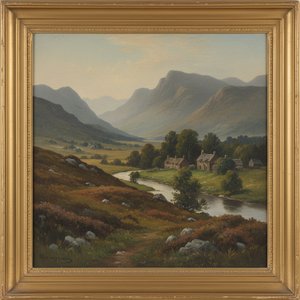
La Vision Romantique de Robert Scott Lauder
Au cœur de l'Édimbourg du XIXe siècle, une époque définie par une profonde révérence pour le patrimoine et les émotions impétueuses du mouvement romantique, Robert Scott Lauder s'est imposé comme une voix essentielle de l'art écossais. Né le 25 juin 1803 à Silvermills, Lauder était le fils de John Lauder, un respecté propriétaire d'une tannerie locale. Son éducation au sein d'une famille éminente d'Édimbourg lui a offert une base de stabilité et un accès culturel qui allaient finalement le propulse vers les sommets de la reconnaissance académique. Si ses premières années étaient ancrées dans le paysage industrieux de l'Écosse, son âme artistique était destinée aux scènes plus grandioses de l'Europe, cherchant à traduire l'esprit littéraire dramatique de son époque en récits visuels éternels.
La formation intellectuelle de Lauder débuta à la Royal High School, mais ce sont ses voyages ultérieurs qui affinèrent véritablement sa sensibilité esthétique. Cherchant à maîtriser les complexités de la lumière et de la forme, il s'immergea dans les grands centres artistiques du continent, notamment Rome, Florence, Bologne, Venise et Munich. Ces longues périodes d'études à l'étranger lui permirent d'absorber les traditions classiques de l'Italie et les techniques académiques rigoureuses de l'Allemagne, en les mêlant à une sensibilité typiquement écossaise. Cette éducation cosmopolite le prépara à son moment charnière en 1830, lorsqu'il fut élu l'un des membres fondateurs de la Royal Scottish Academy, une distinction qui consolida son statut parmi l'élite intellectuelle et artistique de sa nation.
Récits de Légende et de Littérature
L'essence véritable de l'œuvre de Lauder réside dans sa relation profonde et symbiotique avec la littérature de Sir Walter Scott. Alors que les contes du romancier sur la chevalerie, la tragédie et l'identité nationale captivaient l'imaginaire victorien, Lauder chercha à donner à ces mots une présence physique et picturale. Il ne se contentait pas d'illustrer des histoires ; il tentait de capturer l'atmosphère même de l'histoire romancée de Scott. Ses toiles servent souvent de fenêtres sur une époque révolue, où les frontières entre le fait historique et le mythe poétique s'estompent avec beauté.
Son œuvre est marquée par plusieurs accomplissements monumentaux qui témoignent de sa capacité à orchestrer des drames d'envergure :
- The Poet (Le Poète) : Un portrait poignant de Sir Walter Scott lui-même, qui transcende la simple ressemblance pour capturer une aura de profonde contemplation intellectuelle et le poids d'un héritage littéraire.
- The Shepherd Boy (Le Jeune Berger) : Une scène tendre et évocatrice tirée de l'univers d'Ivanhoe, démontrant sa capacité à trouver le sublime au cœur de moments intimes et de scènes de genre.
- The Battle of Flodden Field (La Bataille de Flodden Field) : L'une de ses œuvres les plus ambitieuses, ce tableau dépeint la défaite historique écossaise avec une maîtrise de l'éclairage dramatique et du mouvement expressif, incarnant la grandeur tragique du passé de l'Écosse.
Technique, Héritage et Esprit Romantique
Observer un tableau de Lauder, c'est être témoin de la puissance tactile de la technique de l'empâtement. Il privilégiait une application épaisse et vigoureuse de la peinture, ce qui lui permettait de manipuler l'ombre et la lumière d'une manière qui intensifiait les enjeux émotionnels de ses sujets. Cette approche texturée conférait un sentiment d'immédiateté et de vie à ses scènes historiques, rendant la poussière des combats ou la douce lueur d'un après-midi pastoral presque palpables pour le spectateur. Son coup de pinceau n'était jamais purement décoratif ; c'était un outil expressif utilisé pour transmettre les émotions turbulentes centrales au mouvement romantique.
Au-delà de sa prouesse technique, la signification de Lauder réside dans son rôle de pont entre les traditions classiques du passé et l'identité nationale naissante de l'Écosse. Par son dévouement à la peinture historique, il a aidé à codifier un langage visuel pour l'héroïsme et le romantisme écossais. Bien qu'il soit décédé en 1869, laissant derrière lui un héritage entrelacé avec la trame même de la Royal Scottish Academy, sa capacité à insuffler la vie aux légendes de Sir Walter Scott garantit que son travail demeure un témoignage captivant de la puissance de l'imagination.
Questions et réponses
Puis-je parcourir les œuvres de Robert Scott Lauder par ambiance ?
La L'ambiance par émotion de Robert Scott Lauder est une page qui organise les œuvres de l'artiste par ambiance.
D'où vient Robert Scott Lauder ?
Robert Scott Lauder est né(e) en Écosse.
Où peut-on retrouver les œuvres de Robert Scott Lauder classées par sujet ?
La page Atlas thématique répertorie les œuvres de Robert Scott Lauder par sujet.
Existe-t-il une liste complète des œuvres de Robert Scott Lauder ?
Chaque œuvre de Robert Scott Lauder sur ce site web peut être consultée depuis la page Toutes les œuvres de l'artiste.
Dans quelle ville et quel pays Robert Scott Lauder est-il/elle né(e) ?
Robert Scott Lauder est né à Édimbourg, en Écosse.
Comment puis-je trouver des œuvres de Robert Scott Lauder dans une palette spécifique ?
Les œuvres de Robert Scott Lauder peuvent être parcourues par palette de couleurs sur la page Par palettes de l'artiste.
Où et en quelle année Robert Scott Lauder est-il né ?
Robert Scott Lauder est né à Édimbourg en 1803.