L'héritage de Raphaël Coixcie : Un visionnaire de la Renaissance
Né dans la ville historique de Malines, en Belgique, vers 1540, Raphaël Coixcie s'impose comme une figure charnière du paysage artistique de la Haute Renaissance—une période caractérisée par une créativité sans précédent et des idéaux humanistes. Son héritage dépasse largement ses peintures individuelles, façonnant les tendances stylistiques et influenante des générations d'artistes qui lui ont succédé. Bien que les détails biographiques demeurent quelque peu rares comparés à ceux de contemporains tels que Michel-Ange ou Léonard de Vinci, la contribution de Coixcie à l'art flamand est indéniable, faisant de lui une voix majeure de la ferveur artistique bourgeonnante de son époque.
Les années de formation de Coixcie furent imprégnées d'une profonde tradition artistique. Il reçut l'enseignement de Raffaello Sanzio da Urbino—communément appelé Raphaël—un maître dont l'influence imprégna l'œuvre de jeunesse de Coixcie. Ce lien avec les maîtres italiens lui apporta une attention méticuleuse aux détails et une maîtrise magistrale du clair-obscur, ce jeu dramatique entre l'ombre et la lumière. Cette technique devint la pierre angulaire de son approche, lui permettant d'insuffler à ses toiles une émotion et une profondeur palpables, reflétant l'esprit humaniste qui dominait la pensée de la Renaissance. Les échos stylistiques du travail de Raphaël sont particulièrement manifestes dans les premières compositions de Coixcie, témoignant d'un profond respect pour les idéaux classiques et d'un dévouement à capturer la forme humaine avec une précision remarquable.
Maîtrise de la forme et récit sacré
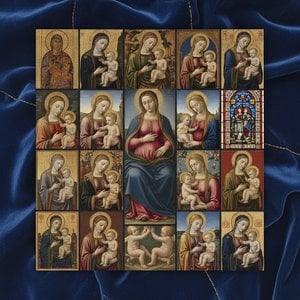
L'étendue de la production artistique de Coixcie s'étend à divers médiums, notamment la fresque et la peinture à l'huile, chacun témoignant de sa polyvalence technique. Son travail cherchait souvent à combler le fossé entre le terrestre et le divin, utilisant le paysage et la lumière pour élever les sujets religieux. Dans des œuvres telles que sa Vierge à l'Enfant lisant dans un paysage, on peut observer une représentation sereine de la maternité et de la foi, où le monde naturel sert d'écrin silencieux à la contemplation spirituelle. Sa capacité à intégrer les figures dans des décors luxuriants et atmosphériques souligne sa maîtrise de la perspective et de la théorie des couleurs.
Au-delà de la dévotion religieuse, Coixcie fit preuve d'une capacité exceptionnelle à capturer le poids de l'autorité politique et historique. Son Portrait du pape Jules II est une étude magistrale du détail, présentant le pape de la Renaissance dans de riches robes rouges, mettant l'accent sur la texture du tissu et le jeu de la lumière sur le visage. Cette capacité de réalisme s'étendait même à ses études plus contemplatives, comme sa représentation poignante de la figure de Diogène. Dans cette œuvre, Coixcie utilise une atmosphère sombre et un style classique pour explorer les thèmes de la philosophie et de la solitude, prouvant que son talent résidait autant dans la profondeur psychologique que dans l'exactitude physique.
Importance historique et impact artistique
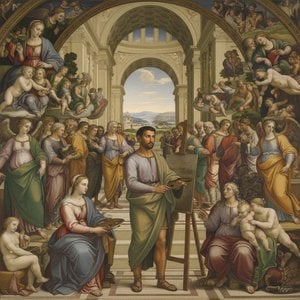
L'importance historique de Raphaël Coixcie réside dans son rôle de trait d'union entre les traditions de la Renaissance italienne et l'évolution de l'école flamande. En synthétisant l'échelle monumentale et l'éclairage dramatique du Sud avec les compétences d'observation détaillées caractéristiques de l'art du Nord, il a aidé à créer un langage stylistique unique. Ses contributions aux œuvres de grande envergure, y compris sa participation à d'importants projets de fresques, ont laissé une marque indélébile sur les traditions décoratives et narratives de l'art européen.
Pour comprendre l'étendue de son impact, on peut considérer les piliers suivants de sa carrière :
- Innovation technique : L'utilisation sophistiquée du clair-obscur pour créer une profondeur tridimensionnelle et une résonance émotionnelle.
- Influence classique : Un dévouement de toute une vie aux idéaux humanistes et à la précision anatomique hérités des grands maîtres italiens.
- Polyvalence des sujets : Une capacité à passer sans transition de la tendresse intime des Madones à la gravité imposante du portrait papal.
- Pont culturel : Son rôle dans l'apport de l'esthétique raffinée de la Haute Renaissance aux centres artistiques bourgeonnants de la Belgique.
Bien que des siècles se soient écoulés depuis sa mort en 1616, les œuvres de Raphaël Coixcie continuent de captiver l'œil moderne. Elles demeurent des fenêtres vitales sur une période de l'histoire humaine où l'art, la science et la spiritualité étaient inextricablement liés, invitant les spectateurs à redécouvrir la beauté d'un maître qui a su capturer l'essence même de l'esprit de la Renaissance.
Questions et réponses
Puis-je parcourir les œuvres de Raphaël Coixcie par mouvement ?
Les mouvements dans lesquels Raphaël Coixcie a travaillé sont consultables sur la page Tous les mouvements de l'artiste, qui regroupe les œuvres par mouvement.
Où trouver les œuvres de Raphaël Coixcie classées par couleur ?
Les œuvres de Raphaël Coixcie peuvent être explorées par couleur sur la page Index spectral de l'artiste.
Dans quelle ville et quel pays Raphaël Coixcie est-il/elle né(e) ?
Raphaël Coixcie est né à Mechelen, en Belgique.