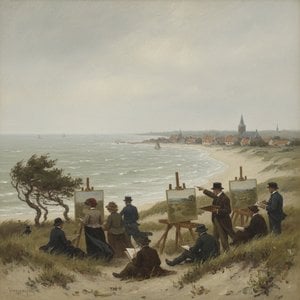
Pinchus Krémègne (Hebrew: פנחס קרמין; Russian: Пинхус Кремень; 28 July 1890 – 5 April 1981), was a Lithuanian Belarusian Jewish-French artist, primarily known as a sculptor and painter of the School of Paris. He stands apart from his contemporaries—Soutine, Kikoine, Kossoff, Auerbach—as an artist who quietly observed and rendered the beauty of nature with remarkable sensitivity. While overshadowed by more flamboyant figures like Chagall, Krémègne’s contribution to modern art deserves renewed appreciation for its understated elegance and profound connection to place.
Early Life and Artistic Training
Born in Zhaludak near Lida, Belarus (now Lithuania), Krémègne experienced firsthand the turbulent realities of Jewish life under Tsarist rule. Marked by pogroms—violent anti-Jewish riots—he emigrated to Paris in 1912, seeking refuge from persecution and pursuing artistic ambitions. His formative years were spent studying sculpture at Vilnius Academy of Art, grounding him in a disciplined approach to form and materiality that would inform his later paintings. This early training instilled a meticulous attention to detail and an understanding of how to capture the essence of a subject through careful observation—qualities that would become hallmarks of his artistic style. He was particularly influenced by Cézanne’s geometric simplification, recognizing its impact on his own visual language.
Joining Montparnasse and Embracing Impressionism
Paris welcomed Krémègne into the vibrant milieu of Montparnasse, where he quickly established himself as one of its respected residents alongside fellow artists like Michel Kikoine and Maurice Sterne. He swiftly adopted Impressionistic techniques, prioritizing light and color to convey atmosphere and emotion rather than striving for photographic realism. Influenced by Gauguin's expressive use of pigment, Krémègne developed a distinctive visual language characterized by textured surfaces and muted palettes—a deliberate contrast to the bolder styles prevalent at the time. His palette favored earthy tones and subtle gradations, reflecting his fascination with geological formations and capturing the mood of twilight landscapes. He was encouraged by Soutine to come to Paris in 1913, recognizing Krémègne’s talent and fostering a lasting artistic partnership.
Ceret: A Sanctuary for Landscape Painting
From 1920, Krémègne sought solace and inspiration in Ceret, France—a small town nestled in the Pyrenees mountains that attracted other painters such as Soutine and Picasso. Drawn to the region’s dramatic landscapes—the rugged peaks, expansive valleys, and shimmering Mediterranean coast—he produced a prolific body of work depicting scenes of rural Catalonia with remarkable precision and lyrical beauty. The village became his artistic home and a focal point for his creative output. He built a modest house overlooking Ceret around 1960, mirroring the simplicity and tranquility he sought in his life’s work. This dwelling served as a constant reminder of his connection to place—a key element in Krémègne's artistic vision. His paintings from this period are notable for their masterful rendering of geological textures and subtle tonal gradations, anticipating later developments in Abstract Expressionism.
Later Years and Legacy
Krémègne continued to paint until his death in Ceret in 1981, maintaining a quiet life devoted to his art. Despite being largely unrecognized during his lifetime— overshadowed by the fame of Soutine and Chagall—a posthumous exhibition in Paris in the 1990s brought renewed attention to his work. Critics praised Krémègne’s landscapes for their understated elegance and profound connection to place, recognizing them as precursors to artists like Kossoff and Auerbach who explored similar themes of materiality and perception. Today, Krémègne's paintings are exhibited in museums across Europe, ensuring that his contribution to modern art—a quiet voice amidst the clamor of artistic innovation—will continue to resonate with audiences for generations to come. He remains a testament to the power of observation and the beauty of simplicity.
Par la rédaction de WahooArt.com
Quiz d'art
Chaque question ne comporte qu'une seule bonne réponse.
Question 1:
Quel mouvement artistique est associé à Pinchus Krémègne ?
Question 2:
Avec qui Pinchus Krémègne collaborait étroitement à Paris ?
Question 3:
Où Pinchus Krémègne établit-il son atelier ?
Question 4:
Quelle discipline artistique était principalement connue chez Pinchus Krémègne ?
Explore the ethereal beauty of the Hague School art movement. Discover how masters like Jan Weissenbruch captured the atmospheric grey light of the Dutch landscape through unparalleled technique and emotive, misty compositions.
Explore the profound legacy of the Barbizon School. Discover how masters like Corot and Monet revolutionized landscape painting through plein air techniques and the soulful depiction of nature's light and shadow in this expert art history guide.
Delve into the breathtaking world of the Hudson River School. Our expert guide explores how 19th-century masters captured the sublime majesty of the American wilderness through Romanticism and unparalleled landscape artistry. A must-read for fine art enthusiasts.
Bonjour ! Je peux vous aider à choisir une œuvre d'art, à suivre une commande ou à répondre à vos questions sur la garantie. Comment puis-je vous aider ?