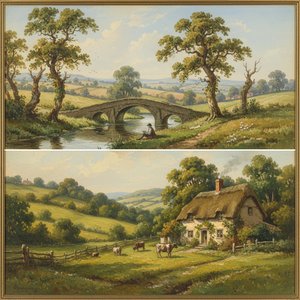
Le Père de la Peinture de Paysage Moderne
Paul Sandby s'impose comme une figure charnière de l'histoire de la peinture de paysage britannique, reconnu non seulement pour son talent artistique, mais aussi pour avoir instauré une nouvelle tradition esthétique qui a profondément marqué les générations suivantes. Né à Nottingham de l'union avec Thomas Sandby, un ouvrier textile, la jeunesse de Paul fut marquée par l'autodidaxie et une fascination innée pour l'observation—des qualités qui allaient s'avérer déterminantes dans le façonnement de sa carrière extraordinaire, tant en tant que cartographe que peintre. Contra-irement à de nombreux artistes de son époque ayant suivi une formation formelle, Sandby a perfectionné son art de manière indépendante, s'imprégnant du monde naturel et documentant méticuleusement sa beauté à travers l'aquarelle.
Ses années de formation lui ont inculqué un profond amour pour le détail et la précision, des compétences qui allaient plus tard se traduire sans transition dans ses travaux cartographiques. Son frère Thomas, également dessinateur, a nourri cette inclination artistique en encourageant l'expérimentation et en favorisant un esprit de collaboration. Ensemble, ils fondèrent une académie à Nottingham, attirant des artistes aspirants désireux d'apprendre de leur expertise. Leur style distinctif—caractérisé par des lavis de couleurs lumineux et une maîtrise magistrale de la perspective atmosphérique—devint instantanément reconnaissable et profondément influent à travers les îles Britanniques.
Topographie et l'Esprit de la Terre
Le parcours professionnel de Sandby fut singulièrement façonné par son implication au sein du département de dessin militaire de la Tour de Londres. Ce rôle le propulsa dans une position qui allait l'exposer à la grandeur de l'Écosse durant la rébellion jacobite. Chargé de créer des cartes topographiques et des croquis des paysages des Highlands, il devint un chroniqueur visuel de l'histoire, se transformant d'un simple illustrateur en l'un des plus grands artistes de paysage de son époque. Cette période de service lui permit de fusionner la précision du cartographe avec l'âme de l'artiste, capturant la majesté sauvage du terrain écossais avec une clarté sans précédent.
Son œuvre reflète une polyvalence remarquable, allant de panoramas grandioses à des instantanés urbains intimistes. Dans sa célèbre série London Cries, telle que la représentation poignante de A Man with a Bottle, Sandby a capturé le pouls rythmique de la vie de rue au XVIIIe siècle. Il possédait une capacité rare à déceler la beauté dans le banal, documentant les personnages et le commerce de Londres avec un réalisme charmant qui demeure captivant pour l'œil moderne. Qu'il peignait les scènes fluviales tranquilles de Llangollen ou l'énergie bouillonnante de la Horse Fair on Bruntsfield Links, son travail a toujours conservé un sens de la vérité topographique doublé d'une lumière poétique.
Héritage et Innovation Artistique
En tant que membre fondateur de la Royal Academy, Sandby joua un rôle crucial dans l'élévation du statut de l'aquarelle. Avant son influence, l'aquarelle était souvent reléguée au rang d'esquisse préparatoire ou de simple outil pédagogique ; cependant, grâce à sa maîtrise du médium, il a aidé à l'établir comme une forme d'art noble et respectée, capable d'une expression profonde. Son utilisation de la gravure à l'aquatinte a en outre permis à ses vues détaillées de toucher un public plus large, propageant la beauté du paysage britannique à travers toute l'Europe.
L'importance historique de Paul Sandby réside dans sa capacité à jeter un pont entre la documentation scientifique et l'expression romantique. Son héritage se retrouve dans :
- Le développement de la tradition de l'aquarelle anglaise : en établissant les fondements techniques pour les futurs maîtres du médium.
- L'excellence topographique : en fusionnant la précision de la cartographie avec la puissance émotive de l'art paysager.
- La documentation culturelle : en préservant le tissu social de la Grande-Bretagne du XVIIIe siècle à travers ses observations urbaines et rurales détaillées.
Par son dévouement inlassable à observer le monde, Sandby a fait bien plus que peindre des paysages ; il a appris à une nation comment contempler sa propre beauté.
Questions et réponses
Dans quelle ville et quel pays Paul Sandby est-il/elle né(e) ?
Paul Sandby est né à Nottingham, en Royaume-Uni.
D'où vient Paul Sandby ?
Paul Sandby est né(e) en Royaume-Uni.
Où et en quelle année Paul Sandby est-il né ?
Paul Sandby est né à Nottingham en 1798.
Dans quels mouvements Paul Sandby a-t-il travaillé ?
Les mouvements dans lesquels Paul Sandby a travaillé sont consultables sur la page Tous les mouvements de l'artiste, qui regroupe les œuvres par mouvement.
Comment la carrière de Paul Sandby est-elle divisée en périodes ?
Un récit chronologique de l'œuvre de Paul Sandby est disponible sur la page Chronologie de l'artiste, où les œuvres défilent par ordre de création, chapitre par chapitre.
Puis-je trier les œuvres de Paul Sandby par couleur ?
Les œuvres de Paul Sandby peuvent être explorées par couleur sur la page Index spectral de l'artiste.
Puis-je explorer les œuvres de Paul Sandby par mot-clé ?
Pour trouver des œuvres de Paul Sandby sur un thème spécifique, utilisez la page Par mots-clés de l'artiste, qui regroupe les œuvres par mot-clé.