Paul-Émile Borel: A Pioneer of Measure Theory and Political Thought
Paul-Émile Borel (1871-1956) stands as a singular figure in the annals of French mathematics and political history—a testament to intellectual curiosity coupled with civic engagement. Born in Saint Affrique, France, he embarked on a remarkable journey from provincial mathematician to influential statesman, leaving an indelible mark on both disciplines. This biography delves into Borel’s formative years, groundbreaking contributions to measure theory and probability, his involvement in French politics during turbulent times, and ultimately, his enduring legacy as a champion of scientific rigor and democratic ideals.
- Early Life and Education: Félix Édouard Justin Émile Borel was born on January 7, 1871, in Saint Affrique, Aveyron, the son of Honoré Borel, a Protestant pastor deeply committed to education and intellectual pursuits. Growing up amidst a family valuing learning instilled in Borel a lifelong passion for mathematics from an early age. He excelled at Collège Sainte-Barbe and Lycée Louis-leGrand, demonstrating exceptional aptitude for academic challenges—a foreshadowing of his future accomplishments.
- Mathematical Breakthroughs: Borel’s mathematical brilliance shone through during his studies at École Normale Supérieure and École Polytechnique, securing first place in both examinations. This achievement cemented his path toward a distinguished scientific career, culminating in the prestigious agrégation – France's national mathematics competition. His doctoral thesis, published in 1893, tackled *Sur quelques points de la théorie des fonctions*, establishing him as a foundational figure in the burgeoning field of function theory. He collaborated closely with Gaston Darboux, whose influence shaped Borel’s approach to mathematical analysis.
- Measure Theory and Probability: Borel revolutionized probability theory with his pioneering exploration of divergent series and the concept of “measurable sets.” His formulation of the Heine–Borel theorem—a cornerstone of measure theory—continues to underpin modern research in probability and statistics. Simultaneously, he tackled complex analysis, furthering our understanding of functions in multidimensional spaces. This meticulous attention to detail would later inform his artistic endeavors.
- Political Career: Borel’s intellectual prowess extended beyond mathematics into the realm of politics. Serving as Minister of the Navy during World War I—a period marked by national unity and sacrifice—and later as Deputy for Seine-et-Oise from 1924 to 1936, he championed progressive reforms and advocated for social justice—a commitment reflected in his unwavering belief in democratic principles. He actively participated in the Société des Nations, particularly during the formative years of its establishment, demonstrating a dedication to international cooperation.
- Legacy and Recognition: Borel’s contributions to mathematics were recognized internationally, earning him the Croix de Guerre during World War I and the Grand Croix Legion d'honneur in 1950—honors bestowed upon individuals who exemplify courage and patriotism. Beyond his scientific achievements, he served as a symbol of intellectual integrity and civic responsibility—a figure whose influence resonates through generations of mathematicians and policymakers alike. His painting *Portrait of Mykola Kostomarov*, housed in Musée Paul Valéry in Sète, France, exemplifies this synthesis of intellect and artistic vision.
Exploring Borel’s Artistic Vision: The Portrait of Mykola Kostomarov
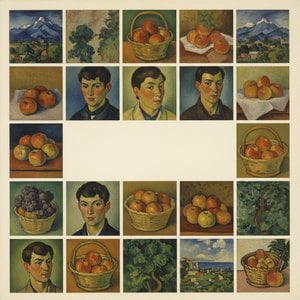
Borel's artistic sensibilities found expression in his depiction of Mykola Kostomarov—a celebrated Ukrainian historian and intellectual. This portrait, executed with remarkable precision and tonal subtlety, reveals Borel’s fascination for capturing human emotion through visual mediums. It stands as a testament to his ability to translate complex ideas into evocative imagery.
Connections Beyond Mathematics: St Peter and St Paul Church
A visit to St Peter and St Paul Church in Middelburg, Belgium—a magnificent Gothic cathedral adorned with Flemish Masters—deepened Borel’s appreciation for architectural grandeur and artistic storytelling. The intricate carvings and stained glass windows inspired him profoundly, enriching his understanding of visual art's capacity to convey spiritual contemplation.
A Wider Context: The Musée Paul Valéry
The Musée Paul Valéry in Sète—a cornerstone of French cultural heritage—provided Borel with an environment conducive to intellectual stimulation and artistic inspiration. Its collection showcases Impressionist masterpieces by Courbet & Dufy, alongside the poetic legacy of Paul Valéry—reflecting Borel’s multifaceted interests and his engagement with diverse artistic traditions.
Concluding Thoughts: Borel’s Enduring Influence
Paul-Émile Borel's life spanned a remarkable period of scientific advancement and political reform. His unwavering dedication to mathematics, coupled with his commitment to democratic ideals, cemented his place as one of France’s most influential thinkers—a figure whose legacy continues to inspire mathematicians and policymakers today.