A Cosmopolitan Vision: The Life and Art of Pascal Marthine Tayou
Pascal Marthine Tayou is a contemporary artist whose work defies easy categorization, existing at the intersection of sculpture, installation, painting, and performance. Born in Douala, Cameroon, in 1967, Tayou’s artistic journey has been profoundly shaped by his experiences navigating multiple cultural landscapes. He spent much of his childhood between Cameroon and Belgium, a duality that instilled within him a unique perspective – one informed by both the vibrant traditions of Africa and the intellectual currents of Europe. This early exposure to contrasting worlds became a foundational element in his art, fueling a lifelong exploration of globalization, migration, identity, and the complexities of postcolonial existence. He initially studied English literature before pursuing fine arts at the Royal Academy of Fine Arts in Düsseldorf, Germany, under the tutelage of renowned artist Jannis Kounellis. This formal training provided him with technical skills but also encouraged a conceptual approach to artmaking that would become his hallmark. Tayou’s work doesn't simply *represent* these themes; it embodies them through its very materiality and process.
From Found Objects to Global Narratives
Tayou first gained recognition in the 1990s for his sculptures constructed from discarded materials – plastic bottles, bicycle parts, furniture fragments – sourced from both Africa and Europe. These assemblages weren’t merely aesthetic exercises; they were potent commentaries on consumerism, waste, and the flow of goods between continents. He transformed these overlooked objects into intricate structures that often resembled architectural forms or fantastical creatures, imbuing them with new life and meaning.
His early work directly addressed issues of economic disparity and environmental degradation, highlighting the impact of global trade on local communities. A key aspect of his practice is the deliberate use of color; vibrant hues borrowed from African textiles and markets are applied to these found objects, creating a visual tension between the mundane and the celebratory. This juxtaposition challenges viewers to reconsider their perceptions of value and beauty. He often incorporates elements of playfulness into his sculptures, inviting interaction and prompting reflection on the relationship between art and everyday life.
Expanding the Scope: Installations and Performance
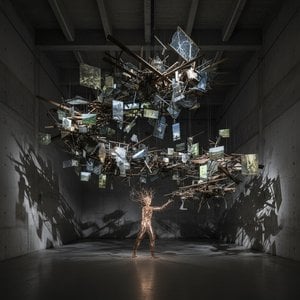
As Tayou’s career progressed, his artistic scope expanded beyond sculpture to encompass large-scale installations and performance art. His installations frequently transform gallery spaces into immersive environments that evoke bustling marketplaces or imagined landscapes.
These works often incorporate sound, light, and scent, creating a multi-sensory experience for the viewer. He is known for his “Muses” – life-sized figures crafted from plastic dolls, often arranged in elaborate tableaux that explore themes of femininity, identity, and cultural representation. These installations are not static displays but rather dynamic spaces that encourage dialogue and participation. Tayou’s performance art further blurs the boundaries between artist, artwork, and audience. He frequently engages with local communities in his performances, creating collaborative works that address social and political issues.
Influences and Artistic Development
Tayou's artistic development has been influenced by a diverse range of sources. The work of Marcel Duchamp and the Readymade movement played a significant role in shaping his conceptual approach to artmaking, encouraging him to question traditional notions of authorship and originality. He also draws inspiration from African traditions of storytelling, ritual, and craftsmanship.
- The vibrant markets of Douala, with their abundance of color and texture, are a recurring motif in his work.
- He is fascinated by the history of colonialism and its lasting impact on Africa, often incorporating historical references into his art.
- His engagement with globalization and migration has led him to explore themes of identity and belonging.
Furthermore, Tayou’s time in Düsseldorf exposed him to the work of artists like Joseph Beuys and Kounellis, who emphasized the importance of social responsibility and political engagement. He skillfully synthesizes these influences into a unique artistic language that is both intellectually rigorous and emotionally resonant.
Historical Significance and Legacy
Pascal Marthine Tayou’s work has garnered international acclaim for its insightful commentary on contemporary issues and its innovative use of materials and techniques. He has exhibited extensively in museums and galleries around the world, including the Venice Biennale, Documenta, and the Tate Modern.
His art challenges viewers to confront uncomfortable truths about globalization, colonialism, and economic inequality, prompting critical reflection on the complexities of our interconnected world. Tayou’s legacy lies not only in his aesthetically compelling artworks but also in his commitment to social justice and cultural exchange. He has established artist-run spaces in Cameroon and other African countries, providing platforms for emerging artists and fostering a vibrant artistic community. His work continues to inspire a new generation of artists to engage with the pressing issues of our time and to explore the power of art as a catalyst for change.