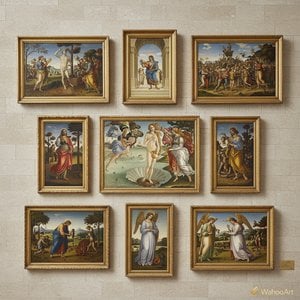
Girolamo Francesco Maria Mazzola, Dit Parmigianino (1503–1540)
Parmigianino, affectionately known as le parmesan, stands as a monumental figure in the artistic landscape of the Italian Renaissance and Early Mannerism. Born in Parma around 1503, his life was tragically cut short at just 37 years old in Cremona, leaving behind an extraordinary legacy of paintings and drawings that continue to captivate audiences centuries later. His distinctive style—characterized by elongated figures, delicate poses, and a masterful manipulation of light and shadow—established him as one of the foremost innovators of his time.
Early Life and Artistic Training
Little is known about Mazzola’s formative years beyond confirming he was born into a family of artists in Parma. His father, Francesco Mazzola, was a sculptor, fostering an environment conducive to artistic exploration. Parmigianino's training likely began under Correggio, a celebrated Mannerist painter who championed expressive distortion and psychological depth—principles that would become hallmarks of Parmigianino’s oeuvre. Correggio’s influence is palpable in Parmigianino’s approach to composition and color, demonstrating the profound impact of artistic mentorship on shaping an artist's vision.
The Height of His Artistic Career: Florentine Patronage
Parmigianino’s artistic reputation soared during his time in Florence under the patronage of Cardinal Giovanni Pier Luigi Farnese, who commissioned numerous portraits and decorative panels. This period witnessed the creation of some of his most iconic works, including “Madonna with the Long Neck,” a painting that exemplifies Mannerist elegance and subtly unsettling beauty. The elongated neck—a deliberate exaggeration—became synonymous with Parmigianino’s style and sparked considerable debate among critics of the era regarding its symbolic significance. Scholars have interpreted this stylistic choice as representing an aspiration for transcendence and divine grace, reflecting the spiritual anxieties prevalent during the Reformation. He also produced stunning frescoes for Palazzo Farnese, demonstrating his mastery of illusionistic technique and furthering the development of Mannerist spatial realism—a groundbreaking achievement that challenged conventional artistic conventions.
Notable Paintings and Drawings
Parmigianino’s artistic output spanned a remarkable range of subjects, reflecting the intellectual currents of his time. Among his most celebrated paintings are “Portrait of Lucrezia Panciatichi,” showcasing an exquisite depiction of aristocratic femininity, capturing the refined beauty and poise characteristic of Florentine noblewomen. His meticulous attention to detail—particularly in rendering fabrics and jewelry—demonstrates Parmigianino’s unparalleled skill as a painter. Furthermore, he created “Saint Francis Adoring the Crucifix,” which embodies spiritual contemplation with meticulous detail, demonstrating his profound understanding of religious iconography and symbolism. His drawings—particularly “Woman Seated on the Ground/Woman Holding a Distaff”—reveal an unparalleled sensitivity to human anatomy and emotion, showcasing his exceptional draughtsmanship skills. These drawings stand as testament to Parmigianino’s artistic genius and underscore his mastery of disegno—the Italian term for drawing—a cornerstone of Renaissance art training.
Style and Influence: Mannerism Revisited
Parmigianino’s artistic style is undeniably rooted in Mannerism—a reaction against the idealized harmony of High Renaissance art. However, Parmigianino pushed Mannerist conventions to their limits, prioritizing expressive distortion over anatomical accuracy and psychological nuance over formal balance. He skillfully employed techniques like sfumato—the subtle blending of colors—to create atmospheric effects that heighten emotional impact. His influence extended far beyond his own lifetime, inspiring subsequent artists who embraced Mannerist principles and shaping the trajectory of European art in the decades following his death. Artists such as Rosso Fiorentino and Federico Zuccarelli acknowledged Parmigianino’s genius and adopted his distinctive visual language—a legacy that continues to resonate with contemporary audiences.
Parmigianino remains an artist whose work continues to captivate viewers today. His paintings—particularly “Madonna with the Long Neck”—are revered for their aesthetic beauty and intellectual complexity. They serve as enduring reminders of the transformative power of art and the brilliance of a singular creative mind, securing his place among the most influential figures in Renaissance art history.