Byoung-Choon Park: Embracing Transparency and Color in Korean Landscape Painting
Byoung-Choon Park (Park Byung-hoon), born in Dongdaemun-gu, Seoul, South Korea in 1966, represents a distinctive voice within contemporary Korean art. His artistic vision centers around the profound exploration of color and transparency—concepts that permeate his entire oeuvre and draw heavily from the traditional Chinese landscape painting style known as Jingyung Shan Shui. This approach distinguishes him from many other artists of his time, prioritizing atmospheric conditions and emotional resonance above mere visual representation.
Early Influences: The Legacy of Shan Shui
Park’s formative years were profoundly shaped by exposure to Korean art history, particularly the serene beauty of Shan Shui paintings. These works—primarily produced during the Ming Dynasty—were celebrated for their misty mountains, flowing rivers, and subtle tonal variations. Artists like Zhu Da and Wang Meng skillfully captured the essence of nature through delicate brushstrokes and nuanced color palettes, conveying a sense of tranquility and contemplation. This stylistic influence instilled in Park a deep appreciation for capturing atmospheric conditions and conveying emotion through nuanced color palettes—a cornerstone of his artistic practice. He recognized that Shan Shui’s core principles could inspire new approaches to landscape painting while honoring Korean cultural heritage.
Technique: Layering Light and Color
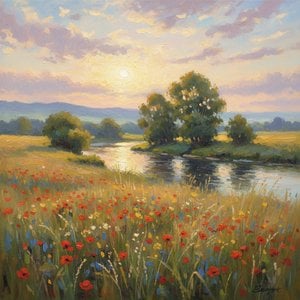
Park’s artistic process is meticulously crafted to achieve maximum transparency. He employs layering techniques—often utilizing multiple thin washes of pigment—to build up complex compositions that reveal underlying hues as the paint dries. This method, reminiscent of Shan Shui masters, allows for an ethereal quality, mirroring the misty landscapes he seeks to portray. Each subsequent layer subtly alters the tonal balance of the preceding one, creating depth and luminosity that captures the elusive beauty of natural light. The artist carefully controls each wash, ensuring it blends seamlessly with its neighbors—a testament to his mastery of traditional painting methods.
Notable Exhibitions: Expanding Horizons Beyond Korea
Demonstrating his commitment to artistic dialogue and expanding his reach beyond Korea’s borders, Park has participated in solo exhibitions in Seoul and Germany, alongside group shows in France. These presentations have garnered critical acclaim from international art critics who recognized the originality of his vision and the sophistication of his technique. Exhibitions at Galerie Eva Meyer Löwenberg in Munich and Fondation Henri Cartier-Bresson in Paris solidified his reputation as a talented artist dedicated to pushing the boundaries of landscape painting—a pursuit that reflects his belief in the transformative power of art.
Google Arts & Culture Presence: Connecting with Global Audiences
Recognizing the importance of digital platforms for disseminating art appreciation, Park’s artwork has been featured prominently on Google Arts & Culture. This collaboration underscores his desire to connect with audiences globally and share his artistic vision with a wider community—a commitment that aligns with his belief in fostering cultural exchange and promoting understanding between artists and viewers alike. The immersive experience offered by Google Arts & Culture allows visitors to explore Park’s paintings in detail, appreciating their subtle nuances and contemplating their evocative imagery.
A Synthesis of Minimalism and Tradition
Park's paintings are not merely representations of scenery; they are meditations on the interplay between light, air, and pigment—a deliberate effort to evoke feelings of tranquility and contemplation. He draws inspiration from Minimalist movement principles while simultaneously honoring Korean cultural heritage. His work embodies a harmonious blend of simplicity and profound artistic expression—a testament to his enduring dedication to exploring the fundamental elements of landscape painting. Byoung-Choon Park’s contribution to the landscape genre is significant not only for its aesthetic beauty but also for its embodiment of Korean cultural heritage and its engagement with universal themes of nature and spirituality.