L'Alchimiste de la Couleur : La Vie et la Vision d'Oleksa Hryshchenko
Parcourir la vie d'Oleksa Hryshchenko, connu dans une grande partie du monde occidental sous le nom d'Alexis Gritchenko, c'est s'embarquer pour un voyage au cœur même du modernisme du XXe siècle. Né en 1883 dans la petite ville ukrainienne de Krevets, les fondations intellectuelles précoces de Hryshmentsko ne furent pas posées dans un atelier, mais dans les couloirs rigoureux du monde académique, où il étudia la philologie et la biologie dans les universités de Kyiv, Saint-Pétersbourg et Moscou. Pourtant, sous cette discipline scientifique et linguistique battait le cœur d'un artiste destiné à jeter un pont entre les anciennes traditions spirituelles et les géométries fracturées de l'avant-garde. Sa transition de chercheur en sciences de la vie à maître de l'expression visuelle marque l'une des transformations les plus profondes de l'histoire de l'art d'Europe orientale.
La trajectoire de sa carrière fut irrévocablement modifiée par ses rencontres avec les courants révolutionnaires traversant l'Europe. Une visite pivot à Paris en 1911 l'initia au langage radical du cubisme, un mouvement qui lui offrit une nouvelle manière de déconstruire la réalité en ses formes essentielles. Cependant, Hryshchenko ne se contenta jamais d'une simple expérimentation formelle ; il recherchait une synthèse plus profonde, plus habitée. Ses voyages en Italie entre 1913 et 1914 lui permirent de communier avec les maîtres de la première Renaissance, tandis que sa fascination profonde pour l'iconographie byzantine lui servit d'ancrage spirituel. Cette intersection unique — où la rigueur structurelle du cubisme rencontrait l'essence lumineuse et sacrée de la tradition orthodoxe — devint la marque de fabrique de son style mature.
Une Symphonie de Couleur et de Lumière
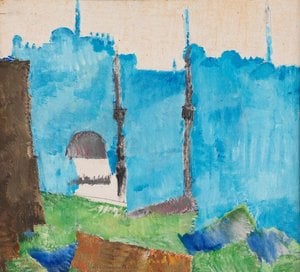
L'évolution artistique de Hryshchenko s'appréhende au mieux à travers son concept de « tsvetodynamos », ou dynamique des couleurs. S'éloignant des palettes réductrices et souvent monochromes du premier cubisme, il développa une approche expressionniste vibrante qui cherchait à capturer la résonance émotionnelle de la lumière et de l'atmosphère. Son œuvre devint une danse de nuances diaphanes, où les limites entre les objets se dissolvaient dans un jeu rythmique de pigments. Qu'il s'agisse de rendre les paysages ensoleillés de Constantinople, la beauté sauvage de la Grèce ou les panoramas sereins de la Riviera française, sa touche possédait une qualité immédiate et viscérale, traduisant l'expérience perceptible en une vision intérieure.
Sa maîtrise technique ne se limitait pas à l'huile sur toile ; il était un créateur polyvalent qui trouvait une expression profonde dans l'aquarelle, le dessin et la lithographie. Dans ces médiums, on peut observer la capacité de l'artiste à équilibrer une délicate translucidité avec des traits structurels audacieux. Ses œuvres tardives, particulièrement celles créées lors de sa longue résidence en Provence, reflètent un lien profond avec le paysage, faisant écho aux héritages de Cézanne et de Van Gogh tout en conservant sa vitalité rythmique singulière. Cette période de sa vie, passée sous la lumière du sud de la France, vit l'aboutissement d'un style simultanément moderne par son énergie et ancien par sa profondeur spirituelle.
L'Héritage d'un Visionnaire Cosmopolite
La signification historique d'Oleksa Hryshchenko réside dans son rôle de médiateur culturel. Il se tenait au carrefour de l'Orient et de l'Occident, traduisant les valeurs esthétiques de son héritage ukrainien dans un langage qui résonnait avec l'avant-garde internationale. Sa carrière fut marquée par des expositions prestigieuses à Paris, New York et Lviv, et ses œuvres trouvèrent leur place dans des collections estimées telles que l'Institut Ukrainien d'Amérique et les collections permanentes de grands musées français. Il n'était pas seulement un peintre, mais aussi un théoricien de l'art et un mémorialiste, documentant méticuleusement les liens entre l'art sacré historique et la pratique contemporaine.
En réfléchissant à son immense contribution au monde de l'art, plusieurs piliers clés de son héritage émergent :
- La Synthèse des Traditions : Sa capacité inégalée à harmoniser les innovations géométriques du cubisme avec la grandeur spirituelle de l'art byzantin et de la Renaissance.
- La Dynamique des Couleurs : Le développement d'un langage expressif unique centré sur la puissance émotionnelle de la lumière et le mouvement des palettes chromatiques.
- Le Rôle de Pont Culturel : Sa contribution à l'introduction des sensibilités artistiques ukrainiennes au premier plan des mouvements modernistes parisiens et mondiaux.
- La Profondeur Intellectuelle : Une carrière définie par la rare combinaison de rigueur scientifique, d'intuition théorique et de pure intuition créatrice.
En fin de compte, Hryshchenko demeure une figure singulière — un peintre qui a regardé vers l'arrière, vers les icônes du passé, pour trouver les outils nécessaires à la peinture du futur. Sa vie, s'étendant des terres slaves jusqu'aux côtes méditerranéennes, témoigne du pouvoir de l'art à transcender les frontières, les langues et les époques.