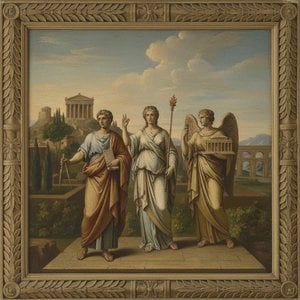
Niccolò dell'Abate: Bridging Renaissance Italy and Baroque France
Niccolò dell’Abatte (c. 1509 – 1571) stands as a pivotal figure in the Mannerist movement, skillfully blending Italian artistic traditions with burgeoning influences from France during his prolific career. Born in Modena, he emerged from a milieu steeped in sculptural excellence—his father was a violinist—and benefited from formative training alongside Alberto Fontana under Antonio Begarelli, absorbing stylistic cues from Ferrarese masters like Garofalo and Dosso Dossi. His artistic journey represents a fascinating convergence of humanist ideals and innovative visual experimentation.
Early Influences: The Echoes of Correggio and Parmigianino
Dell’Abatte's artistic sensibilities were profoundly shaped by the titans of Renaissance art – Correggio and Parmigianino – experiences that propelled him toward a distinctive Mannerist style characterized by elongated figures, dramatic poses, and intricate spatial illusions. These masters championed expressive distortion and psychological depth, techniques which Dell’Abatte skillfully adopted, prioritizing emotional impact over strict realism. Observing their groundbreaking approaches to perspective and composition instilled in him a desire to push artistic boundaries.
Modena Years: Monumental Frescoes and Mythological Narrative
His early commissions included monumental frescoes for Palazzo dei Beccherie in Modena, demonstrating his mastery of perspective and narrative composition—particularly evident in *The Aeneas Cycle*, which showcased his ability to convey complex mythological themes with meticulous detail. This ambitious project cemented his reputation as a leading artist of his time and exemplifies the Mannerist preoccupation with conveying profound ideas through visual storytelling. The frescoes are notable for their masterful use of chiaroscuro, creating dramatic contrasts that heighten emotional resonance.
Bologna & Fontainebleau: Collaboration and Artistic Diffusion
Dell’Abatte's relocation to Bologna marked a crucial juncture, fostering collaborations with prominent artists and establishing him as a leading decorator for aristocratic patrons. Simultaneously, his appointment at the Château de Fontainebleau under Francesco Primaticcio cemented his role in introducing Italian Renaissance aesthetics into French artistic circles. At Fontainebleau, Dell’Abatte contributed significantly to Primaticcio's visionary designs, shaping the decorative arts of the era and disseminating humanist ideals across Europe. His involvement ensured that Florentine artistic principles would resonate powerfully within the royal court.
A Diverse Oeuvre: Landscapes, Genre Scenes and Mythological Visions
Dell’Abatte’s oeuvre is remarkably diverse, encompassing landscapes imbued with atmospheric depth—particularly influential for Claude Lorrain and Nicolas Poussin—genre scenes depicting courtly life and mythological narratives interwoven with humanist ideals. He skillfully blended classical influences with Mannerist stylistic conventions, resulting in artworks that are both intellectually stimulating and aesthetically captivating. His monumental frescoes at Sassuolo, notably *Orlando Furioso*, exemplify his ambition to create immersive visual experiences that captivated audiences. These paintings demonstrate a profound understanding of theatrical illusionism and contribute to the legacy of Italian Renaissance art.
Legacy: Drawings and Enduring Influence
Dell’Abatte's drawings—particularly those housed in the Louvre—offer invaluable insight into his artistic process and contribute to our understanding of Mannerist technique. His meticulous attention to detail and expressive draughtsmanship underscore the importance of disegno, or drawing, as a cornerstone of Renaissance art training. Furthermore, Dell’Abatte’s influence extended beyond immediate commissions, shaping subsequent generations of painters and establishing him as a cornerstone of European art history. Reproductions of his works can be found at
WahooArt, ensuring that his artistic vision continues to inspire admiration and scholarly study.