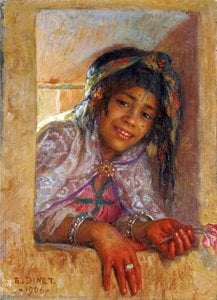
Le Savant Parisien et le Rêve Algérien
Né au cœur de Paris le 28 mars 1861, Alphonse-Étienne Dinet entame son voyage dans les couloirs prestigieux du Lycée Henry IV. Fils d'un éminent juge français, sa jeunesse fut imprégnée de rigueur intellectuelle et de l'atmosphère raffinée de la Belle Époque. Sa formation académique à l'Académie Julian et à l'École nationale supérieure des Beaux-Arts lui conféra la maîtrise technique de la tradition française, pourtant, sous ce socle classique, germait une curiosité insatiable qui allait l'entraîner bien au-delà des frontières de France. Ce fut sa rencontre avec le Maghreb qui allait véritablement embraser son esprit artistique, transformant un étudiant de la tradition française en un chroniqueur de la vie nord-africaine.Une Âme Transformée par le Désert
La relation de Dinet avec l'Algérie était bien plus qu'un simple intérêt professionnel ; ce fut une profonde métamorphose spirituelle et culturelle. À mesure qu'il s'imprégnait des paysages et des coutumes de la région, les frontières entre l'observateur et l'observé commencèrent à se dissoudre. Cette connexion profonde culmina avec sa conversion à l'islam, le menant à adopter le nom de Nasreddine Dinet—un titre signifiant « défenseur du Dīn ». Il ne s'agissait pas seulement d'un changement de nomenclature, mais d'un basculement fondamental de perspective. En maîtrisant l'arabe et en traduisant sa littérature, il acquit une compréhension intime et intérieure de la culture qu'il dépeignait. Son œuvre cessa d'être celle d'un étranger regardant de l'extérieur ; elle devint le témoignage vibrant d'une vie qu'il avait véritablement embrassée, caractérisée par un niveau d'authenticité ethnographique sans précédent.La Maîtrise de la Lumière et de la Vérité Ethnographique
L'art de Nasreddine Dinet se définit par une synthèse époustouflante entre l'idéalisme romantique et l'observation méticuleuse. Puisant son inspiration dans l'usage magistral de la lumière et de la couleur propre aux œuvres d'Eugène Delacroix, Dinet possédait une capacité singulière à capturer les atmosphères changeantes du soleil algérien. Ses toiles vibrent de la chaleur du désert et des nuances tendres de l'existence quotidienne. Qu'il dépeigne l'intensité dramatique de L’Oued M'sila après la pluie ou l'innocence calme et poignante de Girl Playing With Her Brother, ses coups de pinceau transmettent à la fois une précision scientifique et une profonde résonance émotionnelle. Il a su capturer la texture des étoffes, le grain du sable et la lueur douce du crépuscule avec une précision qui honorait la dignité de ses sujets.Un Héritage Durable dans l'Art Orientaliste
Au-delà de ses toiles individuelles, l'impact de Dinet sur le monde de l'art fut structurel et durable. En tant que l'un des fondateurs de la Société des Peintres Orientalistes, il a aidé à façonner la direction du mouvement, l'orientant vers une représentation plus respectueuse et authentique de la vie nord-africaine. Sa capacité à mêler l'exotisme de l'Orient à la sophistication technique de la peinture française a laissé une marque indélébile dans l'histoire de l'art. Aujourd'hui, ses œuvres demeurent des témoignages essentiels d'une période d'échanges culturels intenses, s'érigeant comme des fenêtres lumineuses sur un monde où l'art, la foi et le paysage convergeaient en une harmonie parfaite et baignée de soleil.Questions et réponses
Dans quel pays Nasreddine Dinet est-il né ?
Nasreddine Dinet est né(e) en France.
Combien d'œuvres de Nasreddine Dinet sont disponibles à la consultation ?
Vous pouvez parcourir 58 œuvres œuvres de Nasreddine Dinet sur la page Toutes les œuvres d'art.
Où puis-je admirer les œuvres de Nasreddine Dinet dans une galerie en 3D ?
La Musée en 3D de Nasreddine Dinet vous permet de découvrir les œuvres de l'artiste au sein d'une galerie virtuelle en trois dimensions.