L'Esprit Raffiné de la Dynastie Ming
Mo Shilong (1537–1587) s'érige comme un phare de sensibilité artistique raffinée au sein du paysage culturel vibrant de la fin de la dynastie Ming. Né à Shanghai, plus précisément dans la région de Huating, il a émergé d'un milieu profondément attaché à l'esthétique classique chinoise et profondément façonné par la tradition wenrenhua — la peinture des lettrés — un style privilégiant la contemplation intellectuelle aux côtés d'une exécution magistrale. Contrairement à nombre de ses contemporains préoccupés par de grands récits ou des démonstrations de richesse flamboyantes, Mo Shilong a poursuivi l'excellence artistique avec un dévouement silencieux, laissant derrière lui un héritage caractérisé par une beauté sobre et une profonde maîtrise technique. Sa vie, bien que tragiquement interrompue au début de la cinquantaine, fut marquée par un engagement indéfectible envers les idéaux érudits de son époque.
Les fondements de son art furent posés au sein d'une famille imprégnée de traditions calligraphiques ; son père, Mo Ruzhong, fut le maître de calligraphie du légendaire Dong Qichang. Cette lignée offrit à Mo Shilong une immersion précoce dans les complexités rythmiques du pinceau. Son éducation, ancrée dans l'érudition confucéenne, lui dotèrent du cadre intellectuel crucial pour s'engager avec les courants philosophiques qui façonnaient la pensée artistique des Ming. Plus significativement encore, il tissa un lien profond avec son brillant ami et mentor, Dong Qichang, dont le style révolutionnaire et les écrits critiques allaient finalement définir le canon orthodoxe de la peinture des lettrés-amateurs. Ce partenariat scella l'engagement de Mo Shilong à préserver les vénérables traditions tout en s'orientant simultanément vers une innovation subtile.
Une Maîtrise de l'Encre et de la Lignée
Le style distinctif de Mo Shilong est instantanément reconnaissable comme un hommage profond à Huang Gongwang, figure monumentale de la peinture de paysage de la dynastie Yuan. Dans ses paysages, on observe une adoption délibérée de stratégies compositionnelles monumentales, notamment l'utilisation de motifs horizontaux entrelacés qui créent un sentiment de stabilité durable. Il possédait une capacité remarquable à bâtir des lignes de crêtes montagneuses qui s'imposent avec force dans le cadre de l'œuvre, utilisant l'accumulation de reliefs et de plateaux pour atteindre une puissante sensation de tridimensionnalité. Son travail au pinceau reflète un engagement profond envers l'idéal wenrenhua, où chaque trait sert d'expression du caractère intérieur et de la vitalité spirituelle de l'artiste.
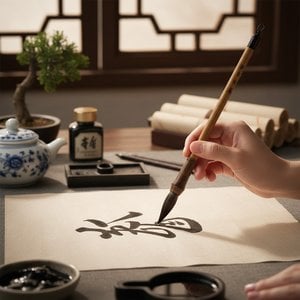
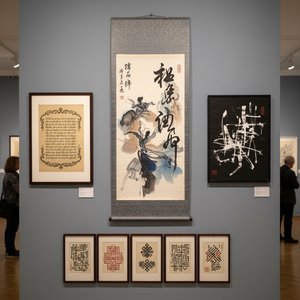
Au-delà des vastes panoramas de ses paysages, Mo Shilong était un maître des arts plus intimes et rythmiques de la calligraphie. Sa pratique calligraphique puisait son inspiration auprès des grands maîtres de l'Antiquité, notamment Wang Xizhi, Wang Xianzhi et Mi Fu. Il excellait dans les écritures cursives et semi-cursives, imprégnant ses caractères d'un flux dynamique et élégant qui faisait écho aux rythmes naturels des paysages qu'il peignait. Cette dualité — la capacité de commander à la fois l'immensité d'un rouleau de paysage et la précision délicate d'un éventail — démontre une maîtrise polyvalente du médium de l'encre. Ses œuvres comprenaient souvent des inscriptions poétiques, telles que celles présentes dans son Printemps en fleurs, où l'interaction entre le texte et l'image crée une expérience multisensorielle de la beauté saisonnière.
Héritage et Importance Historique
Bien que sa carrière ait été écourtée par une mort prématurée, l'impact de Mo Shilong sur l'école de calligraphie de Songjiang et sur le paysage artistique plus large des Ming demeure indélébile. Il n'était pas un simple suiveur de la tradition, mais un contributeur vital à la revitalisation des arts classiques dans son district. Le connaisseur de l'époque, Chen Jiru, nota un jour que la calligraphie et la peinture de Mo Shilong avaient opéré un véritable renouveau, suggérant que même le grand Dong Qichang trouvait l'inspiration dans sa vision. Sa capacité à synthétiser l'esprit monumental des maîtres Yuan avec l'élégance raffinée des lettrés Ming a aidé à maintenir la continuité des valeurs esthétiques chinoises durant une période de transition culturelle majeure.
Aujourd'hui, les œuvres de Mo Shilong servent de fenêtres essentielles sur l'âme de la fin de la dynastie Ming. Que ce soit à travers ses paysages imposants qui évoquent la grandeur sauvage des montagnes anciennes ou ses poèmes calligraphiques délicats capturant l'essence éphémère du printemps, son art continue de résonner avec un sentiment de zhen (sincérité) et de xi (spontanéité). Son héritage est préservé dans des collections prestigieuses telles que le Metropolitan Museum of Art et le Musée de Shanghai, où ses traits de pinceau continuent de témoigner d'une vie dédiée à la quête d'une perfection intemporelle et sobre.
Questions et réponses
Puis-je trier les œuvres de Mo Shilong par couleur ?
Les œuvres de Mo Shilong peuvent être explorées par couleur sur la page Par couleur de l'artiste.
Comment puis-je trouver toutes les œuvres de Mo Shilong par technique ?
Pour retrouver toutes les œuvres de Mo Shilong par technique, rendez-vous sur la page Par technique de l'artiste.
À quelle époque historique Mo Shilong a-t-il vécu ?
Mo Shilong a œuvré durant la période Renaissance. Cette époque permet de situer l'activité de l'artiste dans l'histoire.