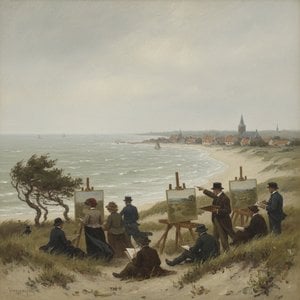
A Legacy of Detail: The Life and Art of Maurice Leloir
Maurice Leloir, born in Paris in 1853, emerged from a lineage steeped in artistic tradition—a heritage that profoundly shaped his meticulous approach to painting and illustration. His father, Auguste Leloir, was a painter himself, while his mother, Héloïse Suzanne Colin, carried on the family’s creative spirit as a skilled watercolorist, daughter of Alexandre-Marie Colin. This nurturing environment instilled in young Maurice not only technical skill but also an appreciation for the nuances of artistic expression. The influence extended to his brother, Alexandre-Louis Leloir, who also became a recognized painter and illustrator, creating a vibrant artistic atmosphere within their family circle.
Early Training and Salon Recognition
Leloir’s formative years were marked by intensive training under his father's guidance—a crucial step in honing his drawing abilities and establishing the foundational principles of his artistic style. Recognizing his talent early on, Auguste Leloir encouraged Maurice to pursue excellence, fostering a dedication to precision that would become a hallmark of his oeuvre. He debuted at the Salon des Artistes Français in 1876, an event pivotal for showcasing emerging artists and garnering critical acclaim. Subsequent exhibitions solidified his position within the Parisian art scene, culminating in his appointment as secretary to the Salon—a testament to his reputation among fellow painters and collectors. This recognition propelled him toward further artistic exploration, cementing his place amongst the leading figures of Impressionism and Academic painting.
The Crozant School and Historical Inspiration
A transformative encounter with the Crozant School profoundly impacted Leloir’s artistic vision. Situated in the picturesque valleys of Creuse, this collective of painters championed landscapes imbued with atmospheric perspective and celebrated the beauty of rural life—influences that resonated deeply within Leloir's creative sensibilities. Working alongside these artists fostered a heightened awareness of naturalism and encouraged him to capture fleeting moments of light and color with remarkable sensitivity. However, Leloir distinguished himself through his singular fascination with historical accuracy—a characteristic that would define his artistic practice for decades to come. He meticulously researched costumes and settings from bygone eras, striving to recreate scenes from the past with painstaking detail—a technique considered innovative at the time. This dedication wasn’t merely decorative; it was driven by a genuine desire to honor history and convey its essence through visual representation. Leloir frequently utilized photographs as references, demonstrating an astute understanding of how visual documentation could inform artistic interpretation.
Illustrator Extraordinaire: Dumas and Beyond
Leloir's prolific illustration career cemented his reputation as one of France’s foremost artists for children’s books—a vocation he pursued with unwavering passion and dedication. His illustrations breathed life into classic tales, capturing their spirit and conveying their moral lessons with vivid imagery and stylistic finesse. Notably, he collaborated on Théodore Cahu’s adaptation of Alexandre Dumas’ *Richelieu*, meticulously recreating the opulent costumes and dramatic atmosphere of Louis XIV's court—a project that showcased his mastery of costume design and artistic storytelling. Furthermore, Leloir became a celebrated illustrator of Alexandre Dumas’ *Les trois Mousquetaires*, capturing the energy and excitement of the Napoleonic era with unparalleled skill. His work transcended mere visual depiction; it transported viewers to another time, immersing them in the grandeur and intrigue of historical narratives.
A Pioneer in Costume History and Hollywood Dreams
Maurice Leloir's contribution extended beyond illustration into the realm of scholarly research—specifically, the study of costume history. Recognizing the importance of preserving cultural heritage, he established the Société de l’histoire du costume (Society for the History of Costume) in 1907—a landmark achievement that ensured the preservation and dissemination of knowledge about fashion trends throughout the centuries. He generously donated his family's extensive collection of fashion prints to the Society, fostering a valuable resource for historians and enthusiasts alike. Later in life, Leloir embraced new horizons when he received an invitation from Douglas Fairbanks to participate in *The Iron Mask*, traveling to Hollywood to contribute his expertise in costume design—a remarkable testament to his versatility and willingness to explore uncharted artistic territories. His memoir, *Five Months in Hollywood with Douglas Fairbanks*, offered a captivating glimpse into the burgeoning film industry of the 1920s and solidified his legacy as an artist who defied convention and pursued excellence across diverse mediums.
Maurice Leloir passed away peacefully in Paris in 1940—leaving behind a rich artistic legacy characterized by meticulous detail, historical accuracy, and a profound appreciation for the beauty of the past. His paintings continue to inspire admiration and scholarly interest today, serving as enduring symbols of French Impressionism and Academic painting—a testament to his unwavering commitment to artistic excellence and his indelible mark on the history of art.