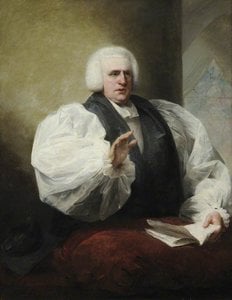
Matthew William Peters (1742–1814): Bridging Art and Faith in Georgian England
Matthew William Peters (1742 – 20 March 1814) occupies a unique position within the annals of British art history—a painter who seamlessly blended the grandeur of Italianate style with a steadfast devotion to Anglican faith. Born in Freshwater, Isle of Wight, he descended from a lineage distinguished by scientific pursuits; his father, Matthew Peters (born at Belfast), was a civil engineer and a respected member of the Royal Dublin Society, instrumental in advising on the enhancement of loughs and rivers for navigation and disseminating two seminal treatises on the subject. This intellectual heritage undoubtedly nurtured Peters’s appreciation for observation and reasoned analysis – qualities that would permeate both his artistic vision and his theological vocation. Peters's formative years unfolded in Dublin, where he honed his artistic skills under Robert West, securing prestigious prizes from the inaugural School of Design in Dublin. Recognizing his prodigious talent early on, the Dublin Society proactively dispatched him to London in 1756 and 1758 to study alongside Thomas Hudson at the Society of Arts, earning a commendation for his diligence—a testament to his unwavering commitment to artistic excellence. Crucially, he embarked upon an Italian pilgrimage between 1761 and 1765 – a transformative journey that indelibly shaped his artistic sensibilities. Inspired by the luminaries of the Renaissance and Baroque eras, Peters meticulously replicated masterpieces by Raphael, Michelangelo, and Caravaggio, adopting their compositional strategies and masterful chiaroscuro techniques—a stylistic hallmark noted by Robin Simon as “no British contemporary had such an Italian manner of painting as peters,” mirroring the venerated masters he emulated. His return to England in 1765 inaugurated a pivotal phase of his artistic career; Peters commenced exhibiting his paintings at the Society of Artists from 1766 to 1769 and subsequently secured admittance to the Royal Academy in 1769, continuing to showcase his works until 1777. During this period, he cultivated enduring connections with fellow artists such as Jean-Baptiste Greuze—whose emotionally resonant genre scenes exerted considerable influence on Peters’s artistic output. Notably, his portraits of the Duke of Manchester and Lord Petre presented at the Royal Academy exhibition in 1785 solidified his reputation as a virtuoso of formal portraiture – characterized by meticulous detail and an idealized portrayal of subject matter. This style reflected the prevailing aesthetic ideals of Georgian England, prioritizing elegance and refinement. Beyond commissioned portraits, Peters produced strikingly erotic artworks that challenged societal conventions of his time—demonstrating a courageous exploration of human desire and vulnerability. These pieces stood apart from his more stately commissions, revealing a willingness to confront uncomfortable truths about human experience – a characteristic distinguishing him as an artist unafraid to transgress artistic boundaries. Furthermore, Peters’s involvement in Freemasonry – becoming Grand Portrait Painter of the Order in 1792 – underscores his multifaceted intellectual curiosity and broadened horizons beyond the realm of visual art. He served as Chaplain to George IV from 1785 until his demise in 1830—a role embodying a harmonious blend of artistic accomplishment and religious scholarship. Peters’s legacy transcends mere artistic achievement; he stands as an emblem of Georgian England's cultural dynamism – bridging the gap between intellectual rigor and spiritual contemplation. His oeuvre exemplifies the stylistic innovations of the era while simultaneously reflecting the moral considerations prevalent within Anglican society—a testament to his enduring significance in British art history and a figure whose work continues to inspire scholarly debate and artistic admiration.Questions et réponses
Puis-je visiter un musée virtuel des œuvres de Matthew William Peters ?
Une visite virtuelle est possible : la page Musée 3D de Matthew William Peters présente les œuvres de l'artiste dans une galerie en trois dimensions.
Combien d'œuvres de Matthew William Peters sont disponibles à la consultation ?
Vous pouvez parcourir 13 œuvres d'art œuvres de Matthew William Peters sur la page Toutes les œuvres.
Puis-je explorer les œuvres de Matthew William Peters par spectre de couleurs ?
Les œuvres de Matthew William Peters peuvent être explorées par couleur sur la page Index spectral de l'artiste.