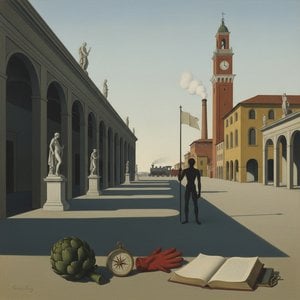
Matteo di Andrea de' Pasti: Sculptor of Renaissance Splendor
Matteo di Andrea de’ Pasti (c. 1420 – after 1468/1469) stands as a pivotal figure in the artistic landscape of Verona and the broader Italian Renaissance, renowned primarily for his monumental sculptures and intricately crafted medals that embody the ideals of humanist artistry and royal patronage. Born in Verona, Italy, he emerged from a tradition steeped in Veronese sculptural excellence, inheriting techniques honed by masters like Giovanni Battista Falcone and Andrea Mantegna—skills which would prove instrumental in shaping his distinctive style. His formative years were marked by exposure to the intellectual ferment of the era, fueled by humanist scholarship and artistic innovation emanating from Florence under Lorenzo de’ Medici. This influence is palpable in his embrace of classical proportions and idealized forms, mirroring the stylistic trends championed by Alberti and Brunelleschi. Notably, he collaborated closely with Leone Battista Alberti on the ambitious Tempio Malatestiano in Rimini—a project that cemented his reputation as a visionary architect-sculptor duo. Together, they conceived and executed a breathtaking edifice incorporating innovative structural solutions alongside stunning sculptural decoration, establishing a benchmark for Renaissance grandeur. Alberti’s architectural principles profoundly impacted Pasti's approach to design, prioritizing harmony and balance – elements he consistently incorporated into his monumental works. Pasti’s prolific output spanned commissions from influential patrons like Lionello d'Este and Sigismondo Pandolfo Malatesta, reflecting the flourishing artistic environment of his time. His sculptures celebrated both religious piety and civic pride, often depicting saints and biblical figures with remarkable realism and emotional depth. The Tempio Malatestiano itself houses several monumental sculptures by Pasti—including a colossal statue of Saint Francis—demonstrating his mastery of scale and expressive power. This ambitious undertaking showcased Pasti’s ability to translate theoretical concepts into tangible artistic achievements, solidifying his place as one of the foremost sculptors of his generation. Furthermore, he produced numerous portraits and busts for noble families across Italy, capturing the likenesses of prominent individuals with meticulous detail and conveying their character through subtle gestures and facial expressions. These portraits exemplify the humanist preoccupation with portraying human dignity and intellect—a hallmark of Renaissance artistic ideals. Beyond sculpture, Matteo de’ Pasti achieved considerable acclaim as a medalist, producing exquisitely crafted coins and commemorative medallions that served as emblems of royal authority and artistic prestige. His medals showcased exceptional technical skill—particularly in embossing techniques—resulting in surfaces adorned with shimmering relief that captivated viewers. These works are now housed in prestigious museums worldwide, including the Cleveland Museum of Art and the British Museum, guaranteeing their enduring legacy as masterpieces of Renaissance metalwork. The intricate detailing and symbolic representations found on his medallions underscore Pasti’s understanding of art's capacity to communicate complex ideas and emotions—a testament to his artistic vision. His contribution to art history extends beyond individual pieces; Pasti’s work embodies the humanist spirit of the Renaissance—a commitment to observation, reason, and the pursuit of beauty informed by classical ideals. He remains a testament to the transformative power of artistic collaboration and the ability of sculptors to elevate architectural spaces into symbols of civic virtue and spiritual contemplation. His legacy continues to inspire artists today, reminding us that true artistry lies in harmoniously blending intellectual inquiry with aesthetic expression.Questions et réponses
Puis-je parcourir les œuvres de Matteo De Pasti par technique ?
La page Par technique regroupe les œuvres de Matteo De Pasti par technique.
Où puis-je voir les œuvres de Matteo De Pasti par ordre chronologique ?
Retrouvez les œuvres de Matteo De Pasti par ordre chronologique sur la page Chronologie des œuvres de l'artiste.
Puis-je parcourir les œuvres de Matteo De Pasti par ambiance ?
Les œuvres de Matteo De Pasti peuvent être explorées par émotion sur la page L'espace des émotions de l'artiste, qui organise les créations selon l'ambiance qu'elles dégagent.