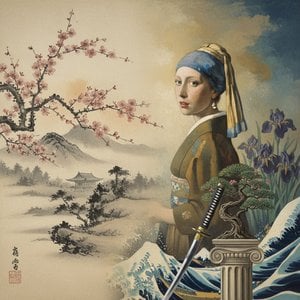
L'Âme de la Lame : La Vie et l'Art de Masatsune Kimura
Au cœur de l'époque d'Edo, une période de profonde transition culturelle au Japon, le nom de Masatsune Kimura s'est imposé comme un symbole à la fois de précision martiale et de grâce esthétique délicate. Né à Tokyo en 1827, Kimura était bien plus qu'un simple artisan ; il était un visionnaire qui a su jeter un pont entre l'utilité létale du sabre samouraï et la beauté contemplative des beaux-arts. Sa vie, s'étendant du crépuscule de l'ancien shogunat à l'aube d'un Japon en pleine modernisation, fut définie par une quête incessante de perfection, qu'elle s'exprimait par le coup rythmique d'un marteau sur l'acier ou par le mouvement fluide d'un pinceau de calligraphie.
Le voyage de Kimura débuta dans l'atmosphère rigoureuse des apprentissages traditionnels. Immergé dans le monde secret et exigeant de la métallurgie, il apprit à écouter le chant du métal, comprenant comment la chaleur, la pression et le carbone pouvaient transformer le fer brut en une arme légendaire. Cette formation précoce était profondément imprégnée des principes du bouddhisme Zen, qui lui enseignait que la véritable maîtrise exige un état de concentration méditative et une connexion intime avec le monde naturel. Pour Kimura, le processus de forgeage était une entreprise spirituelle, où chaque pli de l'acier représentait une couche de discipline et d'intention.
Un Héritage Forgé dans l'Honneur Impérial
Le point culminant de la vie professionnelle de Kimura fut sa nomination en tant que maître forgeron par l'Empereur Yoshinomiya Fushimi. Ce rôle prestigieux le plaça au centre des cercles sociaux et politiques les plus élevés du Japon, lui confiant la création d'armes destinées à l'usage impérial. Une telle responsabilité exigeait un niveau de prouesse technique sans précédent, car ces lames devaient incarner la force de l'empire tout en conservant une élégance exquise. Ses créations de katana et de tachi devinrent renommées pour leur équilibre harmonieux, présentant des tranchants d'une acuité dévastatrice alliés à des surfaces dotées d'une beauté fluide et envoûtante.
Au-delà de la forge, l'esprit artistique de Kimura trouva son expression dans les arts délicats de la calligraphie et de la peinture. Il ne voyait pas ces disciplines comme étant distinctes de sa forge, mais plutôt comme des manifestations différentes d'une même vérité fondamentale : l'importance de la ligne, de l'équilibre et du souffle. Ses œuvres calligraphiques reflétaient souvent la même force et la même détermination que ses lames, tandis que ses peintures capturaient la beauté éphémère du paysage japonais avec une minutie qui faisait écho à sa précision métallurgique.
Signification Historique et Influence Durable
La portée historique de Masatsune Kimura réside dans sa capacité à préserver les traditions ancestrales tout en naviguant à travers une période d'immenses bouleversements. Alors que le Japon s'éloignait de l'ère des samouraïs, l'œuvre de Kimura a servi de lien vital avec un mode de vie en voie de disparition. Ses accomplissements peuvent être résumés par plusieurs piliers essentiels de son héritage :
- Innovation Technique : Il a élevé les standards de la fabrication de sabres japonais en affinant des méthodes de forgeage qui amélioraient à la fois la durabilité et l'attrait esthétique de la lame.
- Synthèse Culturelle : Il a réussi à intégrer la discipline martiale du forgeron aux sensibilités raffinées du peintre et calligraphe classique.
- Reconnaissance Impériale : Son service auprès de l'Empereur a consolidé son statut d'un des artisans les plus respectés du XIXe siècle, garantissant que ses techniques soient documentées et vénérées.
- Art de l'Esprit : En appliquant les principes Zen à son métier, il a transformé l'armurerie fonctionnelle en objets de profonde contemplation philosophique et artistique.
Aujourd'hui, les œuvres associées à Masatsune Kimura sont considérées comme bien plus que de simples artefacts historiques ; elles sont des chefs-d'œuvre de l'accomplissement humain. Que l'on examine le grain complexe d'un tachi ou les traits amples de sa calligraphie, la présence de l'âme de Kimura demeure palpable — témoignage d'un homme qui a maîtrisé l'art de capturer à la fois la force de l'acier et la légèreté de l'esprit.
Questions et réponses
À quelle période historique Masatsune Kimura a-t-il exercé ?
Masatsune Kimura a œuvré durant la période XIXe siècle. Cette période situe l'activité de l'artiste dans l'histoire.
Où et en quelle année Masatsune Kimura est-il né ?
Masatsune Kimura est né à Tokyo en 1827.
Existe-t-il une visite virtuelle en 3D des œuvres de Masatsune Kimura ?
La Musée 3D de Masatsune Kimura est une page qui présente les œuvres de l'artiste dans une galerie virtuelle en trois dimensions.