Marin Le Bourgeoys: The Silent Innovator Behind Henry IV’s Arsenal
Marin Le Bourgeoys (c. 1550–1634) remains a figure shrouded in historical obscurity, yet his contribution to European weaponry and artistic craftsmanship is undeniable. Born in Lisieux, Normandy, France—a region steeped in medieval traditions—Le Bourgeoys ascended from humble artisan beginnings to become one of the foremost gunsmiths and inventors of his era, shaping the trajectory of firearm technology and leaving an indelible mark on Renaissance art. His legacy speaks volumes about a time when artistic brilliance intersected with groundbreaking scientific advancement.
Early Life & Artistic Training
Details surrounding Le Bourgeoys’ early life are scarce—a frustrating absence of documentation that underscores the challenges faced by historians attempting to reconstruct the lives of individuals outside the aristocratic circles. However, existing records suggest he possessed considerable artistic talent from a young age, mastering painting and sculpture under the watchful eye of François de Bourbon, comte de Montpensier, a prominent supporter of Henry IV’s court. This formative exposure to noble art undoubtedly instilled in him an appreciation for meticulous craftsmanship and visual storytelling—skills that would prove invaluable throughout his subsequent career. The patronage of Montpensier ensured access to artistic training unavailable to many others of his time, fostering a creative spirit that transcended mere technical proficiency.
Service Under Henry IV: A Patron’s Recognition
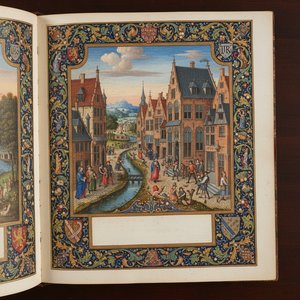
Le Bourgeoys' professional ascent truly commenced when he secured the prestigious position of Valet de Chambre for King Henry IV in 1594—a pivotal moment marking the beginning of his illustrious reign at Versailles. Recognizing Le Bourgeoys’ exceptional aptitude and artistic sensibilities, Henry bestowed upon him generous accommodations within the Louvre—a gesture symbolizing royal esteem and acknowledging his unparalleled talent. During this period, he produced breathtaking artwork, notably “Henri IV (1553–1610) in front of the siege of a town General view” at the Musée de l’Armée (Paris)—a monumental canvas capturing not only regal grandeur but also the visceral drama of military conflict. This commission underscored Henry IV's belief in Le Bourgeoys’ ability to translate historical narratives into compelling visual representations—a testament to his artistic vision and technical mastery.
The Flintlock Revolution: An Engineering Triumph
Le Bourgeoys’ enduring fame rests primarily on his revolutionary invention—the flintlock mechanism. Prior to his pioneering work, firearms were plagued by instability and danger due to primitive ignition systems—resulting in frequent misfires and posing significant risks to operators. Le Bourgeoys’ ingenious design incorporated a “half cocked” position—a subtle yet transformative innovation that dramatically improved safety while maintaining accuracy. This breakthrough swiftly disseminated throughout Europe, establishing the flintlock as the dominant firearm technology for over two centuries—a feat of engineering that fundamentally reshaped warfare and propelled Europe into an era of unprecedented military prowess. His meticulous attention to detail ensured that his invention was both reliable and aesthetically pleasing—demonstrating a harmonious blend of scientific ingenuity and artistic sensibility.
Notable Achievements & Museums
Le Bourgeoys’ inventive spirit extended beyond weaponry; he crafted arquebuses, cornet de chasse, and arbalètes specifically commissioned by Henry IV—instruments destined for royal service and embodying the highest standards of craftsmanship. Furthermore, Louis XIII recognized his genius and entrusted him with numerous weapons for royal use—a privilege reflecting the profound respect accorded to Le Bourgeoys’ accomplishments. Reproductions of his paintings can be found on platforms like WahooArt, ensuring that his artistic vision persists beyond the confines of historical archives. His instruments are housed in prestigious museums such as the Musée National du Château (Versailles), France, offering invaluable insights into Renaissance craftsmanship and military innovation.
Marin Le Bourgeoys’ contribution to both art and science cemented his place as a pivotal figure in European history—a testament to the transformative power of ingenuity and dedication within a period defined by dramatic change.