María Luisa Pacheco : Une pionnière du modernisme andin
María Luisa Pacheco (1919-1982) s'impose comme une figure charnière de l'histoire de l'art bolivien et une contributrice majeure au modernisme latino-américain. Née à La Paz, en Bolivie, son voyage artistique a débuté au cœur du paysage culturel vibrant des Andes — une région qui allait profondément façonner sa vision esthétique et ses préoccupations thématiques tout au long de sa carrière. Ses années de formation furent marquées par l'influence architecturale de son père, Julio Mariaca Pando, nourrissant en elle une appréciation pour les formes géométriques et les relations spatiales qui allaient plus tard imprégner ses peintures.- Formation initiale et influences : Pacheco a suivi une formation artistique formelle à l'Academia de Bellas อres de La Paz, s'immergeant dans les traditions de l'indigénisme bolivien — un style caractérisé par des représentations stylisées des paysages andins et des figures autochtones. Ce socle stylistique a servi de fondation cruciale à ses explorations ultérieures de l'abstraction.
- Les années madrilènes et l'ouverture européenne : Une bourse d'études espagnole a propulsé Pacheco à Madrid en 1951, où elle a perfectionné ses compétences à la Real Academia de Bellas Artes de San Fernando. Durant cette période, elle a rencontré et absorbé les idées artistiques de Pablo Picasso, Georges Braque et Juan Gris — des artistes qui prônaiment l'abstraction géométrique et ont défié les techniques représentatives conventionnelles.
- Bourse Guggenheim et exposition à l'OEA : Reconnaissant son talent et son potentiel, la John Simon Guggenheim Memorial Foundation a décerné à Pacheco trois bourses consécutives en 1956, coïncidant avec une invitation à exposer au Musée de l'Organisation des États Américains (OEA) à Washington, D.C. Cette exposition a consolidé sa réputation d'étoile montante au sein des cercles artistiques latino-américains.
- Résidence à New York et collaborations diverses : S'installant à New York en 1956, Pacheco a poursuivi ses ambitions artistiques tout en s'engageant dans des projets collaboratifs avec des publications telles que le magazine Life et en entreprenant des commandes de design textile — démontrant ainsi sa polyvalence d'artiste à travers divers médiums.
- Héritage et reconnaissance : Ses peintures ont été acquises tant par l'OEA que par la Fondation Guggenheim, assurant leur préservation dans de prestigieux musées d'art et garantissant sa présence durable dans le canon du modernisme latino-américain. Les historiens de l'art reconnaissent deux phases distinctes dans le développement artistique de Pacheco — une période ancrée dans les traditions indigénistes suivie d'une adoption plus expansive des principes de l'expressionnisme abstrait.
Évolution stylistique et techniques artistiques
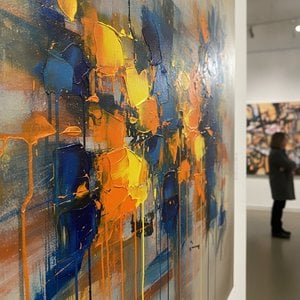
La trajectoire artistique de Pacheco révèle une transformation remarquable, passant de paysages andins stylisés à des abstractions audacieuses et texturées. Initialement influencée par l'accent mis par l'école indigéniste sur la représentation symbolique et les perspectives aplaties — une marque stylistique de l'art bolivien durant les années 1930 et 1940 — elle s'est progressivement tournée vers des techniques rappelant l'expressionnisme abstrait. Ce basculement impliquait l'expérimentation de la superposition de pigments, l'incorporation d'éléments de collage et la manipulation des surfaces pour créer des compositions dynamiques privilégiant la couleur et le geste au détriment du détail précis. Ses toiles se sont trouvées imprégnées d'une énergie et d'une émotion palpables, reflétant son engagement envers les courants philosophiques de l'époque.Œuvres notables et thèmes récurrents
Parmi les peintures les plus célèbres de Pacheco figurent « Sin título » et « Megalith », qui illustrent sa maîtrise magistrale de l'esthétique expressionniste abstraite. Ces œuvres témoignent de sa capacité à distiller des idées complexes en formes visuellement saisissantes — souvent dominées par des teintes vibrantes et des surfaces texturées — qui évoquent la grandeur des montagnes andines et la puissance énigmatique des formations géologiques. Les thèmes récurrents explorés tout au long de son œuvre incluent la spiritualité, la mémoire et la relation entre l'humanité et la nature — reflétant un lien profond avec l'héritage culturel bolivien et une contemplation plus large des questions existentielles.Importance historique et influence
La contribution de María Luisa Pacheco à l'art latino-américain transcende la simple innovation stylistique ; elle a défendu une vision de l'abstraction qui honorait simultanément les traditions andines tout en s'inscrivant dans le ferment intellectuel de l'après-guerre. Son travail a servi d'inspiration aux générations suivantes d'artistes boliviens — particulièrement ceux intéressés par l'exploration du potentiel expressif de la couleur et de la texture — et a ancré sa place comme l'une des voix artistiques les plus importantes de la Bolivie. Elle demeure un témoignage du pouvoir transformateur de l'expérimentation artistique et de l'héritage durable du patrimoine culturel dans le contexte du modernisme mondial.Questions et réponses
Existe-t-il une chronologie de la carrière de María Luisa Pacheco ?
Retrouvez l'itinéraire chronologique de l'œuvre de María Luisa Pacheco sur la page Parcours de carrière de l'artiste, où les œuvres se succèdent par périodes de création, chapitre par chapitre.
Quelles œuvres de María Luisa Pacheco sont les plus consultées ?
Une page Statistiques est disponible pour María Luisa Pacheco, présentant des statistiques sur les œuvres de l'artiste sur ce site.
Comment puis-je voir toutes les œuvres de María Luisa Pacheco ?
Retrouvez toutes les œuvres de María Luisa Pacheco sur ce site en consultant sa page Toutes les œuvres d'art.