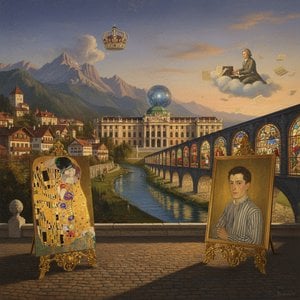
Maria Lassnig, born September 8, 1919, in Kappel am Kraffeld, Austria, experienced a formative childhood shaped by her mother’s tumultuous relationship with an older man—a dynamic that instilled in Lassnig a profound understanding of familial complexity. Raised primarily by her grandmother, this early upbringing would become a recurring motif throughout her artistic oeuvre, reflecting themes of vulnerability and resilience. Her academic pursuits began at the Vienna Academy of Fine Arts during World War II, where she honed her skills and established her distinctive artistic vision amidst the backdrop of wartime anxieties.
Artistic Career and Contributions
Lassnig’s artistic trajectory is characterized by groundbreaking innovations that propelled her into the forefront of Austrian art history. Notably, she spearheaded the introduction of Informalism and Tachisme—styles prioritizing spontaneity and emotional expression—into the postwar landscape. Her involvement with the Hundsgruppe (“Dog Pack”), alongside fellow artists Ernst Fuchs and Wolfgang Hollegha, solidified her position as a pivotal figure in shaping Viennese artistic discourse during the 1950s. Perhaps Lassnig’s most enduring contribution lies in her conceptual framework of “Body Awareness,” articulated in 1948. This theory posits that artists should depict only body parts felt during the creative process—a radical departure from traditional portraiture—resulting in self-portraits imbued with unsettling colors and often featuring missing anatomical elements.
Awards and Legacy
Lassnig’s artistic accomplishments garnered considerable recognition, culminating in several prestigious accolades. She was honored as the first female artist to receive the Grand Austrian State Prize in 1988, cementing her place among Austria's most celebrated creatives. In 2005, she received the Austrian Decoration for Science and Art—a testament to her intellectual curiosity and artistic integrity—and achieved international acclaim at the Venice Biennale in 2013 when awarded the Golden Lion Prize for Lifetime Achievement. Her magnum opus, “Selfportrait with Telephone,” housed at Lentzos Kunstmuseum Linz, exemplifies her masterful technique and unwavering commitment to exploring the human condition. Lassnig’s influence extends beyond her own artistic output; she served as professor emeritus at Vienna University of Applied Arts from 1980 until her passing in 2014, nurturing generations of aspiring artists.
Notable Works and Exhibitions
Lassnig's artistic legacy is vividly preserved through a selection of iconic artworks showcased in prominent museums across Austria and beyond. “Selfportrait with Telephone,” presented at Lentzos Kunstmuseum Linz, stands as a poignant meditation on identity and perception—a testament to Lassnig’s ability to convey profound emotion through subtle visual cues. Her works were featured extensively in exhibitions at the Kunsthistorisches Museum Vienna and the Museum of Applied Arts Vienna, offering audiences unparalleled access to her artistic vision.
Concluding Remarks
Maria Lassnig's pioneering exploration of “Body Awareness” fundamentally altered perceptions of portraiture and artistic representation—a legacy that continues to inspire artists today. Her unwavering dedication to formal experimentation and her profound engagement with existential themes solidified her position as a singular voice in Austrian art history, ensuring her enduring influence on the creative landscape for decades to come.
Par la rédaction de WahooArt.com
Quiz d'art
Chaque question ne comporte qu'une seule bonne réponse.
Question 1:
Quelle école artistique est créditée à Maria Lassnig pour avoir introduit dans l'art autrichien ?
Question 2:
Maria Lassnig a développé une théorie connue sous le nom de « conscience corporelle ». Quelle est la principale attention portée par cette théorie ?
Question 3:
Maria Lassnig faisait partie du groupe artistique influent appelé Hundsgruppe. Quels autres artistes étaient également membres de ce groupe ?
Question 4:
En quelle année Maria Lassnig a reçu la décoration austrienne pour la science et l'art ?
Question 5:
Maria Lassnig a remporté le prix du Lion d’Or pour l’ensemble de sa carrière au Biennal de Venise :
Embark on a sophisticated journey through art history's most captivating masterpieces of reflection. Explore how legendary artists used mirrors to explore identity, surrealism, and the soul through expert art historical analysis.
Embark on a sophisticated journey through Austrian art history. Explore the golden brilliance of Gustav Klimt and the elegance of the Vienna Secession through an expert lens, celebrating the enduring soul of Central European masterpieces.
Embark on a sophisticated journey through the splendor of Austrian art. From Gustav Klimt’s golden masterpieces to the elegance of the Viennese Secession, discover the history and symbolism behind Europe's most iconic works for the discerning collector.
Bonjour ! Je peux vous aider à choisir une œuvre d'art, à suivre une commande ou à répondre à vos questions sur la garantie. Comment puis-je vous aider ?