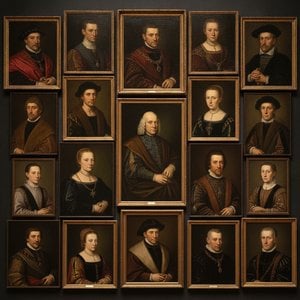
Marcin Kober: The Pioneer of Polish Royal Portraiture
Marcin Kober (also chober, cober, coeber, khober, koeber, koebner), born around 1550 in Wroclaw, Poland, stands as a pivotal figure in the history of Polish art and royal iconography. He wasn’t merely a painter; he was arguably the first artist actively engaged in documenting the reigns of central European monarchs – Stephen Báthory, Rudolf II, Holy Roman Emperor, Queen Anne Jagiellon, and King Sigismund III Vasa – primarily within the Commonwealth of Poland-Lithuania. This distinction elevates him to the status of a precursor to the Polish portrait genre, marking him as an innovator who fundamentally shaped artistic representation during his era. His artistic journey began in Prague, where he encountered the vibrant artistic community fostered by Spanish influences. This exposure profoundly impacted his style, favoring a meticulous realism blended with decorative elements reminiscent of Habsburg court art. Kober’s portraits of Báthory and Rudolf II exemplify this approach, capturing regal dignity alongside subtle symbolic gestures that reflected prevailing humanist ideals. Notably, Kober’s depiction of Stephen Báthory significantly influenced the subsequent royal iconography for over a century, establishing a visual language that would endure through generations. Scholars recognize his masterful execution as instrumental in shaping artistic conventions during this period. The artist's early works at Báthory’s court established a distinct aesthetic – the “Báthory School” – which subsequently impacted the development of Polish sarmatian portraiture. Kober’s meticulous attention to detail and his masterful use of color created images imbued with both psychological depth and formal elegance. His portraits weren't simply representations; they were carefully crafted statements about power, status, and identity. The “Báthory School” is characterized by its restrained palette and emphasis on conveying inner character—a stylistic hallmark that would resonate throughout Polish art for decades to come. A significant contribution to Kober’s legacy lies in his role as the official painter for Queen Anne Jagiellon and King Sigismund III Vasa. These commissions solidified his reputation as a court artist of considerable stature and ensured that his artistic vision would continue to shape royal portraits throughout Poland's golden age. The resulting paintings, particularly those featuring Anna Jagiellon’s widow portrait, are considered invaluable documents of the period, offering insights into aristocratic life and artistic conventions. Kober skillfully captured Anne Jagiellon’s melancholic gaze and dignified posture—a testament to his ability to convey emotion through visual form. Kober's oeuvre spans across multiple museums across Europe, including Dolný Kubín Gallery, Uffizi Gallery, Convent of Las Descalzas Reales, Kunsthistorisches Museum, and National Museum. Versions of Sigismund III Vasa’s portrait exist in both the National Museum and Wilanów Palace, demonstrating Kober's workshop's organizational prowess. The “Wawel Castle Version” stands out as particularly noteworthy – a flat depiction characterized by striking realism and decorative flourishes—a testament to his artistic technique and enduring influence on Polish art history. His work continues to inspire admiration for its precision and elegance, cementing his place as one of the foremost portraitists of his time.- Notable Museums Exhibiting His Work: Dolný Kubín Gallery, Uffizi Gallery, Convent of Las Descalzas Reales, Kunsthistorisches Museum, National Museum
- Key Commissions: Portraits of Stephen Báthory, Rudolf II, Queen Anne Jagiellon, Sigismund III Vasa
- Influences: Habsburg Court Art, Spanish Portraiture Tradition
Questions et réponses
Comment trouver des œuvres de Marcin Kober sur un thème spécifique ?
Les œuvres de Marcin Kober peuvent être explorées par mot-clé sur la page Par mots-clés de l'artiste. Chaque mot-clé regroupe les œuvres associées.
Où puis-je voir la palette de couleurs des œuvres de Marcin Kober ?
L'usage de la couleur par Marcin Kober à travers les œuvres répertoriées sur ce site web peut être étudié sur la page Génome de la palette de l'artiste.
D'où vient Marcin Kober ?
Marcin Kober est né(e) en Pologne.