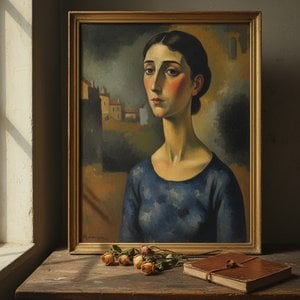
Un visionnaire sicilien : la vie et l'héritage de Manlio Gianrizzo
Manlio Gianrizzo a émergé du paysage culturel vibrant et baigné de soleil de Palerme, en Italie—une ville imprégnée d'histoire ancienne et renommée pour son profond héritage artistique. Né le 3 janvier 1896, au sein d'une famille où le pinceau était une langue commune, Gianrizzo était destiné à une vie de quête créative. Il était le fils du peintre Carmelo Giarrizzo, et son éducation fut enrichie par la présence de ses sœurs, Adele et Maria, qui étaient également des peintres accomplies. Cette immersion familiale dans les arts lui a inculqué une appréciation fondamentale pour la beauté classique et la discipline méticuleuse nécessaire pour capturer le monde sur la toile.
Son parcours artistique formel débuta à l'Istituto d'Arte de Palerme, où il étudia sous la direction du peintre romain Alessandro Morani. Ce fut durant ces années formatrices que Gianrizzo développa une maîtrise technique qui lui permettrait de jeter un pont entre la tradition et l'esprit bourgeonnant de l'expérimentation du XXe siècle. Sa formation initiale lui a insufflé une profonde révérence pour les maîtres du passé, particulièrement les idéaux de la Renaissance incarnés par des figures telles que Raphaël et Fra Angelico. Pourtant, Gianrizzo ne fut jamais un simple imitateur ; il possédait une âme moderne et inquiète qui cherchait à infuser les sensibilités classiques avec l'esthétique évolutive de son époque.
La fusion de la tradition et de la modernité
L'œuvre de Gianrizzo est surtout célébrée pour ses paysages évocateurs et ses portraits sensibles. Ses peintures de la campagne sicilienne sont bien plus que de simples relevés topographiques ; elles sont des méditations émotionnelles sur la lumière, la texture et l'esprit éternel de sa patrie. En utilisant des techniques telles que l'huile sur bois et l'huile sur panneau, il a atteint une richesse tactile qui donnait vie à ses sujets avec une clarté remarquable. Dans ses paysages, on peut ressentir la chaleur du soleil méditerranéen et la dignité tranquille du terrain sicilien, rendus avec une précision qui honore la tradition classique tout en adoptant un coup de pinceau plus moderne et expressif.
Au fil de sa carrière, Gianrizzo a démontré une capacité remarquable à naviguer entre les mouvements artistiques changeants. Bien que ses racines soient restées fermement ancrées dans l'excellence figurative, il n'était pas insensible aux mutations radicales de la scène artistique italienne. Il s'est étroitement associé aux Futuristi Siciliani (Futuristes Siciliens), participant à des expositions majeures telles que la Quadriennale de Rome en 1935. Cette période de sa vie a marqué une évolution stylistique fascinante, où il commença à intégrer des sensibilités plus dynamiques et modernes dans son travail, créant une tension esthétique unique entre l'immobilité du portrait classique et l'énergie du mouvement contemporain.
Une empreinte durable sur l'art italien
Au-delà de ses toiles individuelles, Gianrizzo fut une figure pivot de la communauté artistique organisée de Sicile. En 1924, animé par le désir de favoriser le talent local et de promouvoir une identité artistique sicilienne renouvelée, il cofondat le groupe Artisti Siciliani Indipendenti (Artistes Siciliens Indépendants) aux côtés de collaborateurs tels que Pippo Rizzo, Alfonso Amorelli et Vittorio Corona. Il joua également un rôle crucial dans la création du magazine Aretusa, qui servit de plateforme vitale pour le discours contemporain et la diffusion de nouvelles idées parmi l'intelligentsia méditerranéenne.
L'importance historique de Manlio Gianrizzo réside dans sa capacité à agir comme un conduit culturel. Son travail a été honoré dans des institutions prestigieuses, notamment le Museo Civico di San Gimignano et la Galleria Nazionale d'Arte Moderna e Contemporanea à Rome, où ses peintures sont exposées aux côtés de titans de l'art italien comme Guglielmo Ciardi et Odoardo Borrani. Bien qu'il se soit éteint à Florence en 1957, son héritage demeure le témoignage du pouvoir durable d'un artiste capable d'honorer le poids de l'histoire tout en embrassant sans crainte la lumière de l'avenir.
Questions et réponses
Existe-t-il un aperçu de tous les sujets peints par Manlio Gianrizzo ?
L'Index thématique de Manlio Gianrizzo est une page qui répertorie les œuvres de l'artiste par thématiques.
Où et en quelle année Manlio Gianrizzo est-il né ?
Manlio Gianrizzo est né à Palermo en 1896.
Où puis-je voir la palette de couleurs des œuvres de Manlio Gianrizzo ?
L'usage de la couleur par Manlio Gianrizzo à travers les œuvres répertoriées sur ce site peut être étudié sur la page ADN de la palette de l'artiste.