Museums on APS: Galleria dell’Accademia di Firenze
Master of the Straus Madonna
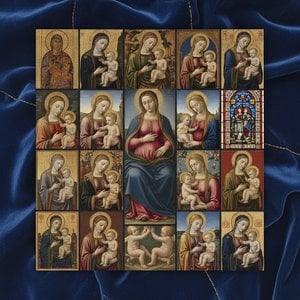
The Master of the Straus Madonna, whose true identity remains elusive despite scholarly efforts, stands as a pivotal figure in Late Gothic Florentine painting—a conduit between Giottesque solemnity and the burgeoning humanist spirit of the early fifteenth century. Primarily recognized for his luminous depictions of Mary holding the infant Jesus, he achieved renown thanks to a donation by the Straus family to the Museum of Fine Arts, Houston, where one of his most celebrated panels currently resides.
Little is known about his life beyond fragmentary documentary evidence suggesting he was born around 1385 in Florence. He emerged as an artist during a period marked by considerable artistic dynamism—a time when Giotto’s influence lingered alongside the revival of classical ideals championed by humanist thinkers like Brunelleschi and Donatello. His stylistic trajectory reflects this complex interplay, demonstrating a masterful assimilation of both traditions.
His oeuvre comprises approximately thirty surviving panels executed in Florence and its environs, predominantly featuring Madonna and Child compositions—a testament to his singular devotion to the Virgin Mary and her divine son. Among these works, the “Man of Sorrows with Instruments of the Passion” (c. 1395), housed in Warsaw’s National Museum, exemplifies his distinctive approach to portraying human suffering—characterized by a subtle modeling of flesh and an expressive gaze that conveys profound emotion. The painting captures the pathos of Christ's agony with remarkable realism, reflecting the humanist preoccupation with psychological depth.
The “Annunciation” (c. 1405), residing at the Accademia Gallery in Florence, represents another cornerstone of his artistic legacy. This painting showcases his exceptional skill in capturing ethereal beauty and conveying spiritual contemplation—a hallmark of Late Gothic art’s preoccupation with divine grace. The delicate drapery folds and luminous coloration contribute to an atmosphere of serene solemnity. It embodies the Florentine ideal of harmonious proportion and refined ornamentation, mirroring the humanist fascination with classical aesthetics.
Furthermore, the “Virgin and Child with Two Angels” (c. 1405), situated in Oxford’s Christ Church Picture Gallery, stands as a paragon of Florentine Late Gothic style—a synthesis of Giottesque solidity and humanist refinement. The subtle nuances of color and texture imbue the scene with palpable warmth and tenderness. This panel demonstrates a masterful blending of Giotto's expressive realism with Brunelleschi's geometric precision, marking a decisive step toward the Renaissance’s artistic innovations.
The Master's influence extended beyond his immediate contemporaries; he served as an inspiration for artists like Masolino, marking a crucial transition from the austere grandeur of the preceding era to the expressive dynamism of the burgeoning Renaissance. His enduring legacy resides in his ability to capture the essence of Christian piety—expressed with unparalleled sensitivity and artistic virtuosity. He remains a symbol of Florentine artistic excellence during a period of profound cultural transformation.
Par la rédaction de WahooArt.com
Quiz d'art
Chaque question ne comporte qu'une seule bonne réponse.
Question 1:
Quel mouvement artistique est associé à l'œuvre du Maître de la Sainte Famille ?
Question 2:
Qui a influencé le Maître de la Sainte Famille ?
Question 3:
Quelle est une caractéristique notable des peintures du Maître de la Sainte Famille ?
Question 4:
Où était actif le Maître de la Sainte Famille principalement ?
Question 5:
Quel artiste a été inspiré par le Maître de la Sainte Famille ?
Embark on a scholarly journey through the spiritual grandeur of Late Medieval art. Discover the intricate symbolism, technical mastery, and profound religious narratives that define the Gothic era in this expert-led guide for art enthusiasts and collectors.
Embark on a journey through the dramatic era of Gothic art. Discover the profound beauty of illuminated manuscripts, sacred gold leaf masterpieces, and the transition to naturalism in this expert-led exploration of medieval artistry and historical grandeur.
Embark on a sophisticated journey through art history with our curated guide to the most iconic Madonna and Child masterpieces. Discover the profound beauty, theological depth, and enduring legacy of these sacred Renaissance treasures.
Bonjour ! Je peux vous aider à choisir une œuvre d'art, à suivre une commande ou à répondre à vos questions sur la garantie. Comment puis-je vous aider ?