Une vie sculptée dans la soie : le monde énigmatique de Madame Grès
Germaine Émilie Krebs, la femme qui allait devenir célèbre sous le nom de Madame Grès, est née au sein d'une famille bourgeoise parisienne en 1903. Dès son plus jeune âge, ses inclinations artistiques penchaient vers la sculpture — un désir de modeler et de façonner la forme qui allait finalement définir son héritage, non pas à travers la pierre ou le bronze, mais par le médium fluide du tissu. Ses parents découragèrent cette voie, l'orientant vers la couture, une vocation plus « appropriée » pour une jeune femme de son époque. Cette réorientation précoce s'avéra déterminante ; elle n'éteignit pas ses ambitions sculpturales, mais les canalisa vers un domaine entièrement nouveau. Elle commença sa carrière comme modiste, perfectionnant ses compétences avant de passer à la couture de haute facture au sein de la prestigieuse Maison Premet, où l'exigence des standards et la méticulosité de la technique étaient primordiales. Ces années formatrices lui inculquèrent un dévouement à l'artisanat qui deviendrait sa marque de fabrique.La naissance d'une signature : d'Alix à Madame Grès
L'évolution de son identité professionnelle — de Mademoiselle Alix à Alix Barton, et enfin à Madame Grès — reflète une construction délibérée d'un personnage, aussi soigneusement pensée que les vêtements qu'elle créait. Le nom « Grès » lui-même émergea en 1942 lors de son mariage avec le peintre russe Serge Anatolievitch Czerefkow, un anagramme de son prénom. Cette période fut marquée par des défis tant personnels que professionnels. Malgré les tourments du Paris de guerre, Grès refusa de compromettre sa vision artistique, continuant à concevoir des robes élégantes qui faisaient subtilement écho aux couleurs du drapeau français — un acte de défi silencieux qui entraîna la fermeture temporaire de sa maison de couture sous l'occupation allemande. C'est pourtant durant cette époque que son style emblématique se cristallisa véritablement : des robes longues, drapées avec une maîtrise inégalée, évoquant la grâce et l'intemporalité de la sculpture grecque classique.Le drapé comme art : une technique révolutionnaire
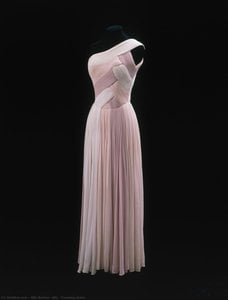
Madame Grès ne se contentait pas de dessiner des robes ; elle les sculptait directement sur le corps. Contra Unlike beaucoup de ses contemporains qui s'appuyaient sur le patronage, Grès préférait travailler directement sur un mannequin, manipulant le tissu — principalement le jersey de soie et le taffetas de papier — avec une compréhension presque intuitive de ses propriétés. Ce processus était notoirement laborieux, nécessitant souvent jusqu'à 300 heures pour une seule robe. Chaque pli, chaque torsion et chaque ondulation était méticuleusement façonné à la main, permettant au tissu de épouser les contours du corps plutôt que de lui imposer une structure rigide. Elle décrivait cela comme une « bataille » entre la créatrice et la matière, une négociation constante entre sa vision et les qualités intrinsèques du textile. Ce dévouement au drapé a élevé la couture au rang d'art, lui valant le surnom de « Sphinx de la mode » en raison de sa nature secrète et de sa concentration inébranlable sur son art.Une influence durable : inspirer les générations
Tout au long des années 1940 et 1950, Madame Grès a habillé certaines des femmes les plus emblématiques de l'époque — la duchesse de Windsor, Paloma Picasso, Grace Kelly, Marlene Dietrich et Greta Garbo, entre autres. Ses créations se caractérisaient par leur simplicité, leur élégance et leur respect de la silhouette féminine. Elle fuyait l'ornementation excessive, laissant la beauté du tissu et l'art du drapé s'exprimer d'eux-mêmes. Son influence s'est étendue bien au-delà du domaine de la haute couture, inspirant une nouvelle génération de créateurs par ses techniques innovantes et son esthétique minimaliste. Azzedine Alaïa, en particulier, fut profondément captivé par le travail de Grès, rassemblant une collection significative de ses pièces — un témoignage de son admiration et une reconnaissance de son héritage éternel.La reine du drapé : une vision intemporelle
L'impact de Madame Grès sur le monde de la mode demeure profond. Son approche pionnière du drapé, son engagement indéfectible envers l'artisanat et sa capacité à transformer le tissu en sculpture portable continuent d'inspirer les designers aujourd'hui. Elle ne s'intéressait pas aux tendances éphémères ; elle cherchait à créer des vêtements intemporels qui célébraient la beauté du corps humain et l'art de la couture. Son œuvre demeure un rappel puissant que la mode peut être bien plus qu'un simple vêtement — elle peut être une forme d'art, un témoignage de savoir-faire et une expression d'une élégance durable. Ses techniques de drapé minimalistes ainsi que son attention et son respect pour le corps féminin ont laissé une empreinte indélébile sur l'industrie de la haute couture et de la mode.Questions et réponses
Comment puis-je suivre l'évolution de l'œuvre de Madame Grès année après année ?
Retrouvez la chronologie des œuvres de Madame Grès sur sa page Chronologie des œuvres, qui les présente par date de création.
Où puis-je admirer les œuvres de Madame Grès dans une galerie en 3D ?
Une visite virtuelle est possible : la page Musée en 3D de Madame Grès présente les œuvres de l'artiste dans une galerie en trois dimensions.
Comment puis-je trouver toutes les œuvres de Madame Grès par technique ?
Pour retrouver toutes les œuvres de Madame Grès par technique, rendez-vous sur la page Par technique de l'artiste.