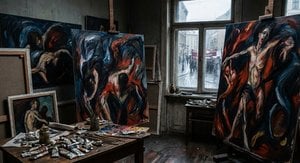
Ma Kelu : Un pionnier de l'art underground de Pékin
Ma Kelu (né le 8 avril 1954 à Shanghai) s'impose comme une figure charnière de l'histoire de l'art contemporain chinois, particulièrement reconnu pour sa contribution au vibrant « Groupe Sans Nom », qui a émergé du creuset du mouvement artistique underground de Pékin à la fin des années 1970 et au début des années 1980. Rejetant le réalisme socialiste dominant prôné par le Parti communiste, Kelu et ses pairs ont tracé une voie vers une abstraction expressive ancrée dans l'expérience personnelle et la liberté intellectuelle — une posture de défi face au dogme officiel qui a profondément façonné la trajectoire de l'art chinois.- Influences précoces et formation (1973-1986) : Le voyage artistique de Kelu a débuté par une formation académique à la Beijing Art Academy, où il a perfectionné ses compétences dans les techniques de peinture traditionnelle tout en s'immergeant simultanément dans les mouvements d'avant-garde occidentaux. Ce double engagement s'est révélé crucial pour le développement de son style distinctif, caractérisé par des palettes de couleurs audacieuses et des coups de pinceau gestuels transmettant une émotion brute et une profondeur psychologique.
- Le Groupe Sans Nom et la Campagne anti-pollution spirituelle : L'implication de Kelu au sein du « Groupe Sans Nom » a marqué un tournant décisif dans l'histoire de l'art chinois. Animé par le désir de défier les contraintes idéologiques, le collectif a organisé des expositions clandestines et a soutenu l'expérimentation artistique — un acte courageux de résistance face à l'atmosphère répressive créée par la « Campagne anti-pollution spirituelle » de Deng Xiaoping.
- Expositions à Berlin et New York (1986-2006) : Suite à la répression des artistes d'avant-garde, l'œuvre de Kelu a acquis une reconnaissance internationale grâce à des expositions à Berlin et New York. Ces scènes ont offert une exposition cruciale à ses peintures expressives et ont consolidé sa réputation en tant que voix majeure de la scène artistique mondiale.
- Reconnaissance et expositions institutionnelles (2006-Présent) : La vision artistique de Kelu a été honorée par son inclusion dans la « Beijing Art Week », sous le commissariat de Gao Minglu, un historien de l'art chinois respecté. Ses expositions monographiques ultérieures au Yuan Center of Art et à la LinBART Gallery ont davantage ancré sa position d'artiste influent repoussant les limites de l'abstraction.
Caractéristiques artistiques clés et thèmes récurrents
Le style artistique de Kelu est instantanément identifiable par son engagement sans compromis envers l'abstraction pure — un rejet délibéré de l'imagerie représentative au profit de l'exploration d'éléments visuels fondamentaux tels que la couleur, la texture et la forme. Ses toiles palpitent de teintes vibrantes — souvent juxtaposées dans des combinaisons inattendues — et sont imprégnées d'épais empâtements qui véhiculent un sentiment palpable de mouvement et d'énergie. Les thèmes récurrents de l'œuvre de Kelu incluent les paysages — particulièrement les scènes de bord de rivière — qui servent de métaphores à la contemplation et à la résilience, reflétant la connexion profonde de l'artiste avec la nature et sa fascination durable pour la résonance émotionnelle.- Riverside (Bord de rivière) : Incarnation de l'émotion et de la texture : L'œuvre « Riverside » de Kelu illustre sa maîtrise magistrale de la couleur et de la texture. Les verts et les beiges dominants du tableau évoquent une atmosphère à la fois tranquille et dynamique, capturant l'essence de la beauté naturelle tout en transmettant un sentiment sous-jacent de vulnérabilité.
- 1989 No.1 : Confrontation et représentation symbolique : « 1989 No.1 » présente un langage visuel plus assertif — caractérisé par des formes angulaires et des couleurs vives — qui évoque les thèmes du bouleversement politique et de la critique sociale. L'utilisation délibérée du symbolisme par Kelu souligne l'importance de transmettre des idées complexes au-delà de la simple représentation littérale.
Influence et héritage
L'œuvre de Ma Kelu a profondément marqué les générations suivantes d'artistes chinois, les inspirant à embrasser l'expérimentation et à remettre en question les normes artistiques conventionnelles. Son dévouement inébranlable à l'abstraction — couplé à sa volonté de confronter les enjeux politiques — a établi un précédent pour la liberté artistique et l'intégrité intellectuelle dans le contexte du paysage culturel évolutif de la Chine. Kelu continue de produire des peintures évocatrices qui résonnent auprès des publics du monde entier, consolidant ainsi sa place parmi les figures les plus significatives de l'art chinois contemporain.Questions et réponses
Dans quelle ville et quel pays Ma Kelu est-il/elle né(e) ?
Ma Kelu est né à Shanghai, en Chine.
Dans quel pays Ma Kelu est-il né ?
Ma Kelu est né(e) en Chine.
Où peut-on trouver les œuvres de Ma Kelu regroupées par technique ?
Pour retrouver toutes les œuvres de Ma Kelu par technique, rendez-vous sur la page Par technique de l'artiste.