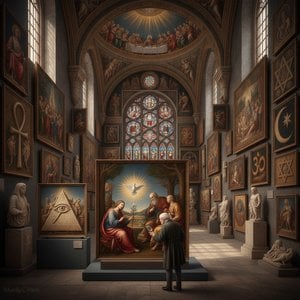
L'Architecte de Royaumes Inaccessibles
Luigi Serafini, né à Rome en 1949, occupe une place singulière dans l'imaginaire contemporain, agissant à la fois comme un architecte de structures physiques et comme un cartographe de mondes impossibles. Rencontrer son œuvre, c'est pénétrer dans un espace liminal où les frontières entre réalité et rêve se dissolvent. Élevé au sein d'une lignée artistique, la jeunesse de Serafini fut imprégnée des nuances de la forme et du design, un socle qui lui permettra plus tard de jeter un pont entre la logique rigoureuse de l'architecture et le chaos fluide du fantastique surréaliste. Son parcours académique à l'ETH Zurich et à l'Università degli Studi di Milano lui a doté d'une compréhension sophistiquée de la dynamique spatiale, pourtant sa véritable vocation résidait dans la construction de langages et de symboles défiant les contraintes de la compréhension humaine.
Le moment décisif de la carrière de Serafini — et peut-être l'une des réalisations les plus significatives de l'art conceptuel de la fin du XXe siècle — est la publication du Codex Seraphinianus en 1981. Cette œuvre monumentale fait office d'encyclopédie d'un monde inexistant, rendu à travers des illustrations méticuleuses dessinées à la main et un alphabet entièrement inventé. Le Codex n'est pas qu'un simple livre ; c'est une provocation profonde contre la tyrannie du sens linguistique. En présentant un système de communication intentionnellement indéchiffrable, Serafini force le spectateur à abandonner la quête d'une traduction littérale pour s'engager plutôt dans la puissance pure et viscérale de la perception visuelle. Entre ses pages, anomalies biologiques, planches de mode surréalistes et spécimens botaniques bizarres coexistent dans un état d'harmonie aussi belle que troublante.
Une Symphonie de Métalangage et de Forme
Au-delà des frontières énigmatiques de son célèbre codex, l'évolution artistique de Serafini a été marquée par une quête incessante du « métalangage » — une manière de communiquer à travers des objets existant en dehors de la sémiotique traditionnelle. Sa pratique se caractérise par une extraordinaire polyvalence, passant sans transition de la précision structurelle du design architectural aux textures fantaisistes de la sculpture céramique, jusqu'à la grandeur théâtrale de la scénographie de ballet. Chaque médium sert de réceptacle à sa fascination pour l'étrange et l'invisible. Dans ses travaux sculpturaux, on découvre une exploration tactile de la forme qui reflète les silhouettes organiques mais extraterrestres présentes dans ses illustrations, créant un univers cohérent où le physique et l'imaginaire sont inextricablement liés.
La maîtrise technique évidente dans son travail est tout simplement à couper le souffle. Qu'il s'agisse de rendre les motifs complexes et vibrants d'une planche de mode venue d'ailleurs ou de sculpter des objets multicouches sophistiqués, on perçoit un sens palpable du détail minutieux. Sa capacité à évoquer l'émotion par des moyens purement esthétiques — sans l'appui d'un langage reconnaissable — est ce qui élève son œuvre de la simple fantaisie à une profonde enquête philosophique. Il nous invite à considérer la nature de l'existence et la fragilité de nos propres systèmes de compréhension. À travers son art, le spectateur est encouragé à embrasser le mystère de l'inconnu, trouvant la beauté dans les choses mêmes qui demeurent à jamais hors de notre portée.
Héritage et Horizon Infini
La portée historique de Luigi Serafini réside dans sa capacité à remettre en question la relation fondamentale entre l'observateur et l'observé. Dans une ère dominée par l'échange rapide d'informations et l'exigence constante de clarté, Serafini offre un sanctuaire d'ambiguïté. Son œuvre témoigne de la puissance durable de l'imagination et de la possibilité de créer du sens par la pure expérience esthétique. Il a fondamentalement transformé le paysage du design contemporain en prouvant que l'art peut opérer de manière totalement indépendante des systèmes linguistiques ou culturels établis.
Aujourd'hui, l'influence de l'approche visionnaire de Serafini se manifeste dans diverses disciplines, de l'illustration surréaliste à la typographie expérimentale et l'installation conceptuelle. Son héritage ne se trouve pas dans un mouvement unique, mais dans la fascination persistante pour l'« intraduisible ». Alors que nous continuons à naviguer dans un monde de plus en plus complexe, les paysages énigmatiques du Codex Seraphinianus et les merveilles tactiles de ses objets métalangages restent essentiels, nous rappelant que les vérités les plus profondes sont souvent celles qui ne peuvent être dites, mais seulement ressenties.
Questions et réponses
Comment puis-je trouver toutes les œuvres de Luigi Serafini par technique ?
Pour retrouver toutes les œuvres de Luigi Serafini par technique, rendez-vous sur la page Par technique de l'artiste.
Dans quel pays Luigi Serafini est-il né ?
Luigi Serafini est né(e) en Italie.
Puis-je visiter un musée virtuel des œuvres de Luigi Serafini ?
Une visite virtuelle est possible : la page Musée en 3D de Luigi Serafini présente les œuvres de l'artiste dans une galerie en trois dimensions.